
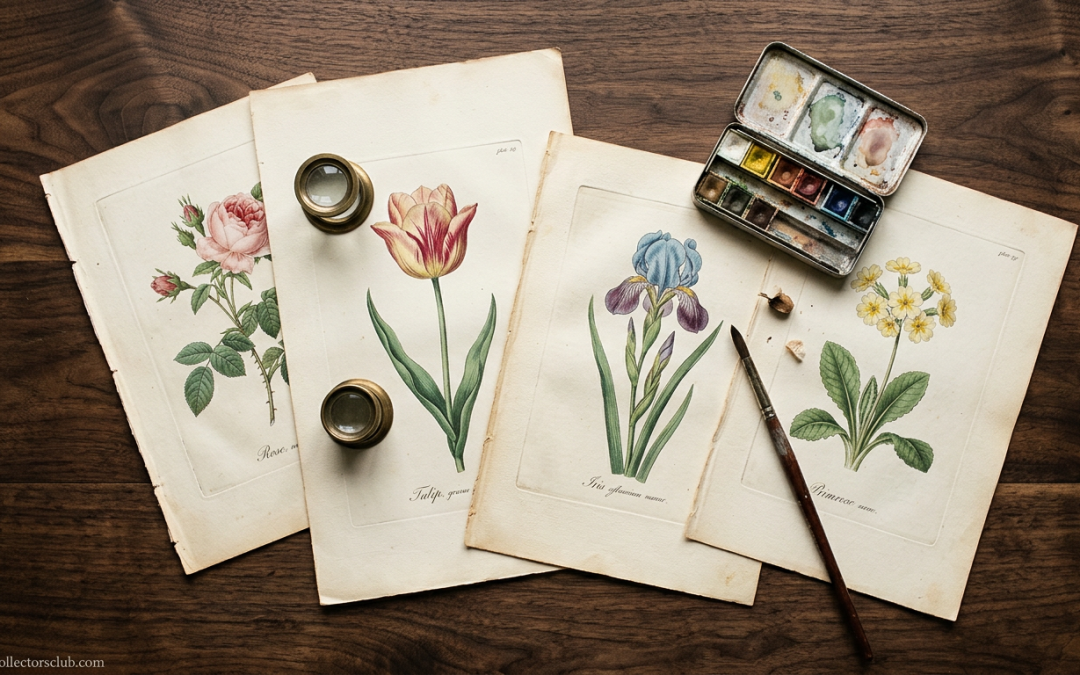
Botanical prints are one of the easiest ways into collecting antique works on paper. They’re beautiful, they come in every price range, and many of them were made with real scientific care, drawn from living plants by artists who knew exactly what they were looking at.
They’re also one of the most reproduced categories of antique art. A framed “antique botanical” at a home goods store is almost always a modern copy. This guide covers where the originals came from, how they were made, and how to tell a period print from a reproduction.
The Golden Age of Botanical Illustration
Botanical illustration took off in the 18th and 19th centuries as plant hunters brought new species back to Europe and wealthy gardeners wanted to know what they were growing. Lavish books like Pierre-Joseph Redouté’s Les Liliacées and Les Roses, and Robert Thornton’s Temple of Flora, turned flower painting into high art.
The publication that did the most to put botanical prints into ordinary hands was a monthly magazine. William Curtis launched The Botanical Magazine in 1787. According to the Linda Hall Library, each early issue had three hand-colored plates with descriptive text and sold for one shilling. It was a hit and is still published today as Curtis’s Botanical Magazine.
That long run is why Curtis plates are so common on the market, and why they’re a good place to start. The University of Glasgow notes that the plates were drawn from living plants and colored by hand until 1948, when a shortage of colorists finally forced the magazine to switch to photographic reproduction.
How Botanical Prints Were Made
Knowing the printing method helps with both dating and authentication.
- Engravings and etchings. The image was cut or etched into a metal plate, inked, and pressed into dampened paper under heavy pressure. That pressure leaves a platemark, a recessed rectangle around the image. Most 18th- and early 19th-century botanicals, including early Curtis plates, are copperplate engravings colored by hand with watercolor.
- Stipple engravings. Instead of lines, the image is built up from tiny dots and flecks. Redouté’s famous roses and lilies were stipple engravings printed in color, then finished by hand.
- Lithographs. These were drawn on stone and printed from a flat surface, so there’s no platemark. Lithography came into wide use in the 19th century, and many later botanicals are hand-colored lithographs.
- Chromolithographs. These are lithographs printed in multiple colors, one stone per color, and they were common by the late 1800s. The color is printed rather than painted, so it looks flatter and more even than hand coloring.
How to Spot a Reproduction
The most useful tool you can own is a 10x magnifying loupe. Here’s what to check.
- Look for dots. Modern reproductions are almost always printed with a halftone screen, a regular pattern of tiny dots that the eye blends into smooth color. Under a loupe, the pattern is obvious. Hand coloring and real engraved lines look nothing like it. The Image Permanence Institute’s Graphics Atlas is an excellent free resource for learning what different printing processes look like up close.
- Check the platemark against the method. An engraving should have a real platemark. A lithograph shouldn’t. Some reproductions add a fake platemark to look old, so make sure the image’s line work actually looks engraved.
- Look at the coloring. Hand-applied watercolor varies slightly from print to print, sometimes pools at the edges, and sits on top of the printed lines. Printed color is uniform.
- Feel and look at the paper. Period paper usually has some texture and natural, uneven toning. Very bright white paper, a glossy coating, or a perfectly even “antique” tan are warning signs.
- Read the margins. Many genuine plates carry a plate number and a publisher’s or engraver’s imprint line. Curtis plates, for example, are numbered. Missing or oddly printed text is worth investigating.
Twentieth-Century Botanical Artists
The tradition didn’t end with hand-colored engravings. Twentieth-century botanical artists worked mostly in watercolor, and their original paintings are a separate, often more valuable, collecting field from the printed plates in their books.
The Scottish artist Mary McMurtrie (1902 to 2003) is a good example. She painted flowers grown in her own garden at Balbithan House in Aberdeenshire. Historic Environment Scotland describes that garden as famous for the plant collection she built there, and she used plants from it for her watercolor studies. Her work is held in serious collections, including the Royal Botanic Garden Edinburgh. Her paintings appeared in several books, including Wild Flowers of Scotland and the posthumous Mary McMurtrie’s Country Garden Flowers.
For artists like McMurtrie, the key question is whether you’re looking at an original watercolor, a signed limited-edition print, or a page from a book. All three exist, and their values differ enormously.
What Drives Value
For antique botanical prints, a few factors matter most:
- The source. Plates from celebrated works like Redouté or Thornton sit at the top of the market. Curtis plates are more affordable because so many were printed.
- Quality of the coloring. Fine, careful hand coloring is worth more than rushed or faded work.
- Condition. Foxing (brown spots), water stains, tears, trimmed margins, and fading all reduce value. Margins matter more than many buyers realize.
- The subject. Showy flowers like roses, tulips, orchids, and lilies tend to sell better than obscure plants.
- Originality. A period impression, especially one with original hand coloring, is worth far more than a later restrike or recoloring.
Buying and Caring for Botanical Prints
Buy from print dealers who state the source, date, and printing method in writing, and who will tell you whether the coloring is original. When you frame a print, use acid-free mats and backing and UV-filtering glass, and keep it out of direct sunlight. Watercolor fades quickly, and fading is the one kind of damage you can’t undo.
Disclaimer: This article is for general information only and is not an appraisal or authentication. Reproductions are common in this field, so consult a qualified print dealer or appraiser before making a significant purchase.
© 2026 by antiquecollectorsclub.com All rights reserved. No part of this document may be reproduced or transmitted in any form or by any means, electronic, mechanical, photocopying, recording, or otherwise, without prior written permission.