
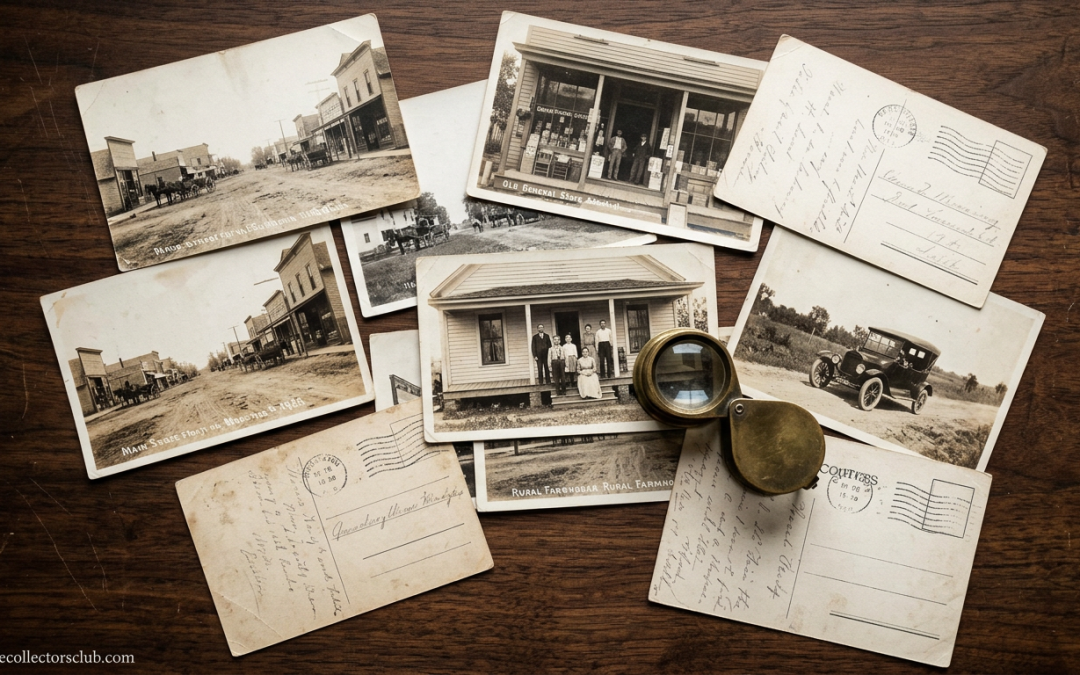
Real photo postcards are where photography stopped being something you went to a studio for. Between about 1903 and the 1930s, ordinary people and small-town photographers turned out millions of them: main streets, train depots, county fairs, floods, family farms, and friends mugging for the camera.
For collectors, that’s the appeal. A real photo postcard (RPPC for short) is often the only surviving image of a building, a business, or an event. And unlike a printed postcard, each one is an actual photograph, developed on photo paper with a postcard back.
This guide covers how to tell a real photo card from a printed one, how to date it using the stamp box on the back, and what makes some cards worth far more than others. It’s the third in our series on early photography, after cartes de visite and cabinet cards.
What Is a Real Photo Postcard?
A real photo postcard is an actual photograph, developed from a negative onto photographic paper that has a postcard back printed on it. Most measure about 3 1/2 by 5 1/2 inches, the standard postcard size.
The format grew out of Kodak’s push to put cameras in everyone’s hands. According to the State Library of Ohio, Kodak released the $1 Brownie camera in 1900, then followed in 1903 with the No. 3A Folding Pocket Kodak. That camera made postcard-sized negatives, so amateurs could have their snapshots printed directly onto postcard-backed paper.
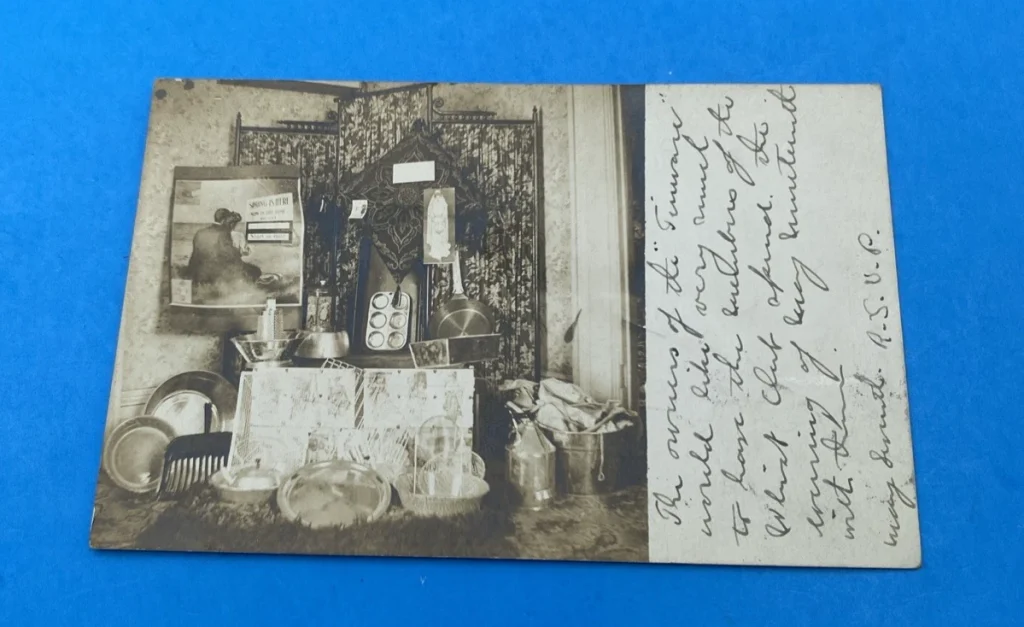
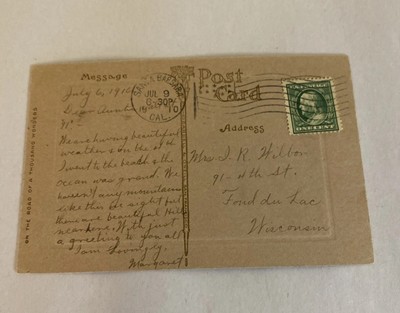
The real boom came after March 1, 1907, when a new postal rule allowed a divided back, with room for a message on the left and the address on the right. Before that, senders had to squeeze their notes onto the picture side. Once people could write on the back, real photo postcards took off.
Small-town photographers built whole businesses around them, shooting main streets, schools, sports teams, parades, and local disasters. Printing companies also mass-produced them for tourist spots. The heyday ran until the 1930s, when cheaper color printing took over, though real photo cards were made into the 1950s.
Real Photo or Printed? How to Tell
This is the first question to answer, because it makes a big difference in value. Plenty of printed postcards were made to look like photographs, and dealers sometimes mislabel them.
The test is simple and needs only a magnifier. Printed postcards were made by lithography or offset printing, so under strong magnification the image breaks up into a pattern of tiny dots, like a newspaper photo. A real photo postcard shows continuous tone, with smooth gradations and no dot pattern at all.
A few other signs help:
- Surface. Real photo cards usually have the sheen of photographic paper, glossy or semi-matte. Dark areas may show silvering, a metallic mirror-like haze that forms as the silver image ages.
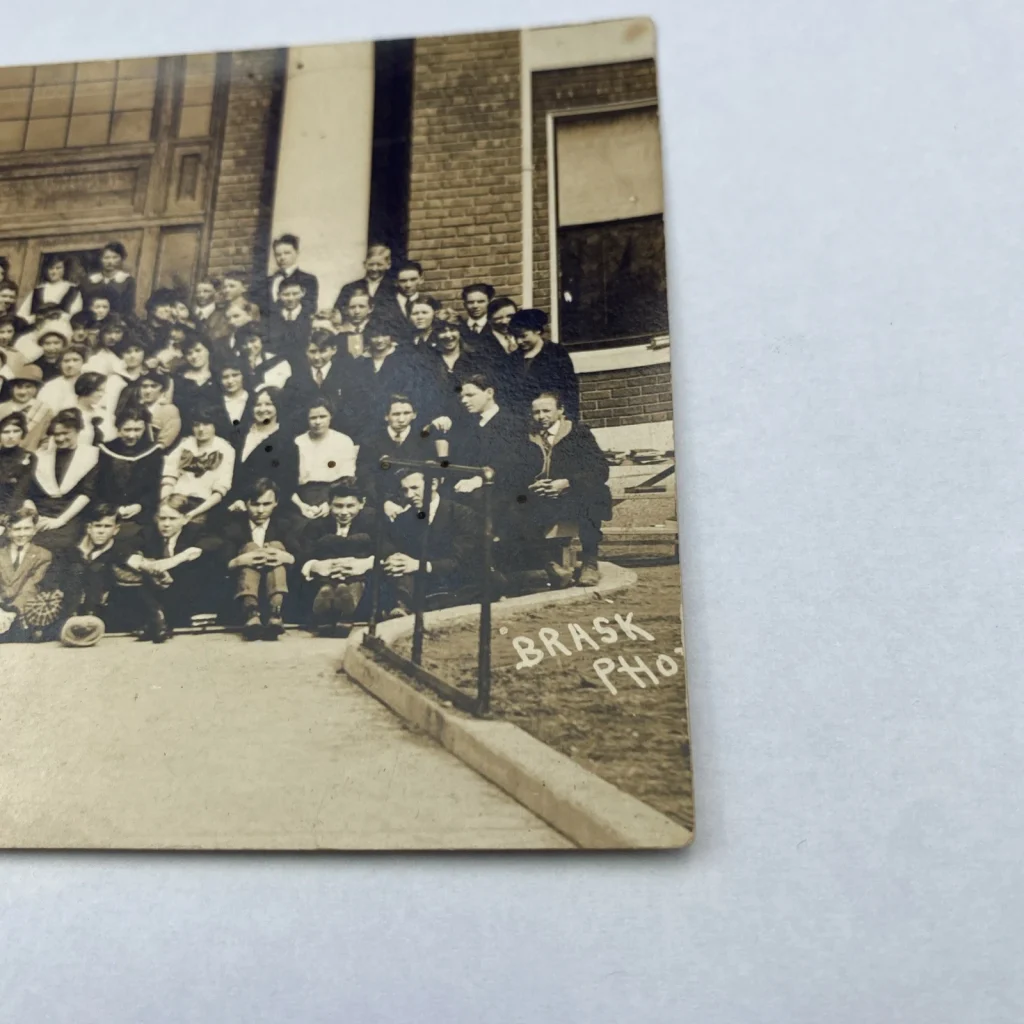
- Captions. Many photographers scratched or wrote a caption onto the negative, so it appears in white lettering on the image. Hand-lettered white captions are a strong sign of a real photo card.
- Edges and color. Printed cards often have crisp printed borders and colors laid down in dots. A colored real photo card was usually tinted by hand, and the color sits on top of the photograph.
- The back. Photographic paper brands printed their names in the stamp box, such as AZO, Velox, or Cyko. A paper maker’s name there almost always means a real photo card.
When in doubt, compare an unknown card side by side with one you know is a real photo. After a few dozen cards, the difference becomes obvious at a glance.
Dating a Card by Its Stamp Box
Turn the card over and look at the little box in the upper right corner where the stamp goes. On real photo cards, the photographic paper company usually printed its brand name there, often with small symbols in the corners. Paper makers changed these designs over the years, which makes the stamp box one of the best dating tools you have.
The standard reference is the stamp box database at Playle’s, compiled by the late postcard dealer Ron Playle. Here are some of the most common designs and their approximate dates of use:
| Stamp box | Corner design | Approximate dates |
|---|---|---|
| VELOX | Squares | 1901 to 1914 |
| SOLIO | Diamonds | 1903 to 1920s |
| AZO | Four triangles pointing up | 1904 to 1918 |
| CYKO | Varies | 1904 to 1920s |
| ARGO | Varies | 1905 to 1920 |
| AZO | Diamonds | 1907 to 1909 |
| NOKO | Varies | 1907 to 1920s |
| ARTURA | Varies | 1910 to 1924 |
| AZO | Two triangles up, two down | 1918 to 1930 |
| AZO | Empty corners | 1922 to 1926 |
| DOPS | Varies | 1925 to 1942 |
| AZO | Squares | 1926 to 1940s |
| EKC | Varies | 1939 to 1950 |
| KODAK | Varies | 1950 to present |
AZO, a Kodak paper, is by far the most common, so it’s worth learning its corner variations first.
Treat these ranges as guides, not hard limits. Paper sat on shelves for a while before use, and different references sometimes give different ranges for the same mark. A KODAK stamp box is a useful warning sign, though. It means the card was printed in 1950 or later, even if the photo shows a much earlier scene, which usually means it’s a later copy of an old image.
Other Dating Clues
The stamp box gives you a range. These clues help narrow it down.
Divided or undivided back. A back with no dividing line, meant for the address only, usually dates before March 1907. A divided back with a message space on the left came after. Combine this with the stamp box: the State Library of Ohio points out that an AZO box with four upward triangles (1904 to 1918) on a divided back narrows the card to 1907 to 1918.
The postmark. A canceled stamp is the quickest way to date a used card. Keep in mind it tells you when the card was mailed, which can be years after the photo was taken.
Postage rates. The stamp’s value is another check. Playle’s postage chart shows the US postcard rate was one cent for most of the early period, rising to two cents during 1917 to 1919 and again from 1925 to 1928, then going to two cents for good in 1952.
Card stock. Early cards tend to use thinner stock with matte backs. Later cards are usually thicker.
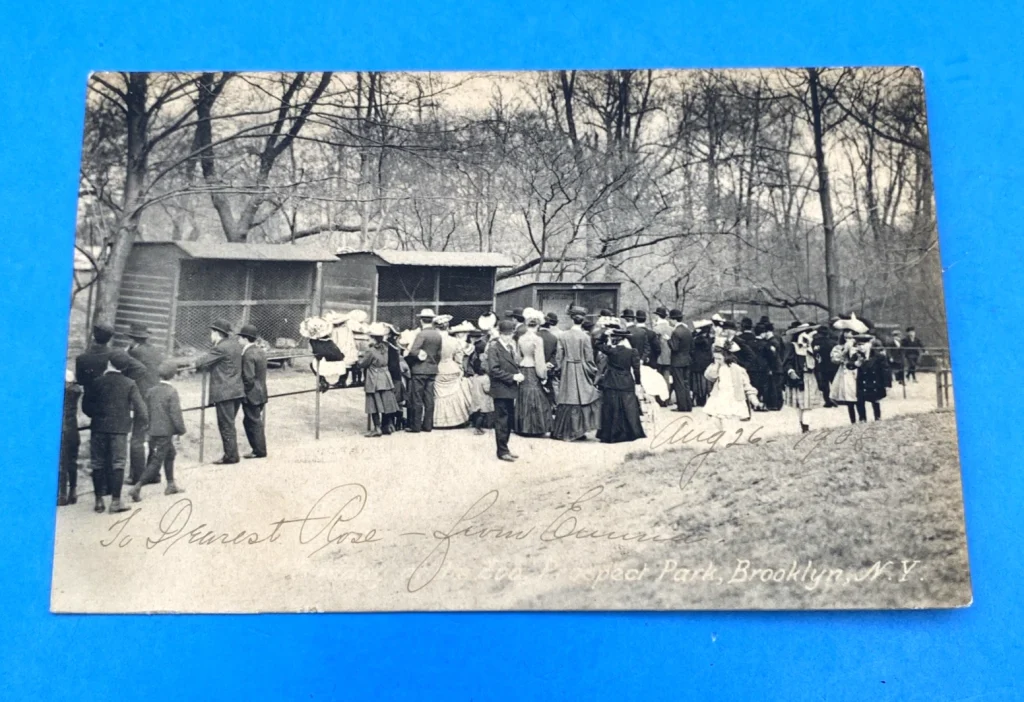
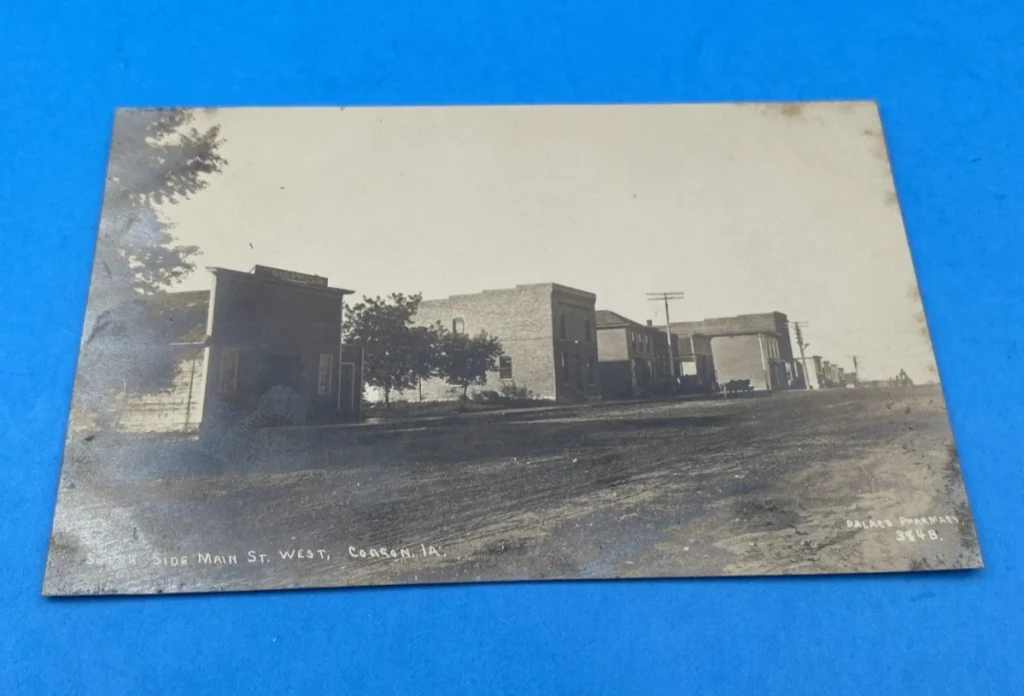
What’s in the picture. Cars, storefront signs, clothing, hairstyles, and men’s facial hair are all useful. A street with horses and wagons points earlier, while paved roads and 1920s cars point later. Captions help too, especially when they name an event or a date, like a flood, a fire, or a parade.
What Makes a Real Photo Postcard Valuable?
Real photo cards are the top tier of postcard collecting, but values range from a dollar or two to thousands. A price guide by dealer Stefano Neis, reprinted on Playle’s, boils it down to four things: age, content, rarity, and demand. In practice, these are the factors that matter most.
Small towns beat big cities. A main street view of a tiny farm town is usually worth far more than a familiar scene from a major city or tourist attraction. Fewer were made, and local collectors and historical societies compete for them.
Identified locations. A card with a caption, postmark, or written note naming the place is worth much more than an unidentified view. If you can’t tell where it is, most buyers won’t pay much.
Storefronts and signs. Shop exteriors and interiors, saloons, gas stations, and delivery wagons are strong sellers. Readable advertising signs add value, especially for well-known brands.
People at work and social history. Blacksmiths, barbers, ice deliverymen, and other trades are popular, as are strikes, suffrage events, and political rallies. Early baseball teams and ballparks are especially sought after.
Early transportation. Identifiable cars, trolleys, early airplanes, and dirigibles all draw interest.
Age and rarity. Cards from before World War I were usually made in small numbers, sometimes just a handful from a single negative. After the war, rotary printing machines turned out thousands of copies at a time.
Condition and clarity. A sharp, well-exposed image in clean condition is worth far more than a blurry or damaged one.
Storing Your Postcards
Real photo cards are photographs, so they need photo-safe storage, not just a shoebox.
Use archival sleeves. The Northeast Document Conservation Center recommends enclosures that pass the Photographic Activity Test (PAT). Uncoated polypropylene or polyester postcard sleeves are inexpensive and widely available. Avoid PVC sleeves and old magnetic albums, which can stain and stick to the cards.
Store them upright in a box. Archival postcard boxes with dividers let you file cards by town, subject, or photographer, and keep them from bending.
Keep the backs visible. Since the stamp box, postmark, and message matter as much as the picture, use clear sleeves so you can read both sides without handling the card.
Watch heat, light, and humidity. Store your collection somewhere cool, dry, and dark. Light fades the image, and humidity causes curling and silvering.
Never remove stamps or soak cards. A stamp and postmark help date the card and add to its value. Leave them in place, even if the stamp is common.
Disclaimer: This article is for general informational purposes only and is not a formal appraisal or authentication. Dating guidelines are general and have exceptions, and market values vary with condition, demand, and provenance. For high-value items, consult a qualified appraiser or postcard specialist.
© 2026 by antiquecollectorsclub.com All rights reserved. No part of this document may be reproduced or transmitted in any form or by any means, electronic, mechanical, photocopying, recording, or otherwise, without prior written permission.