
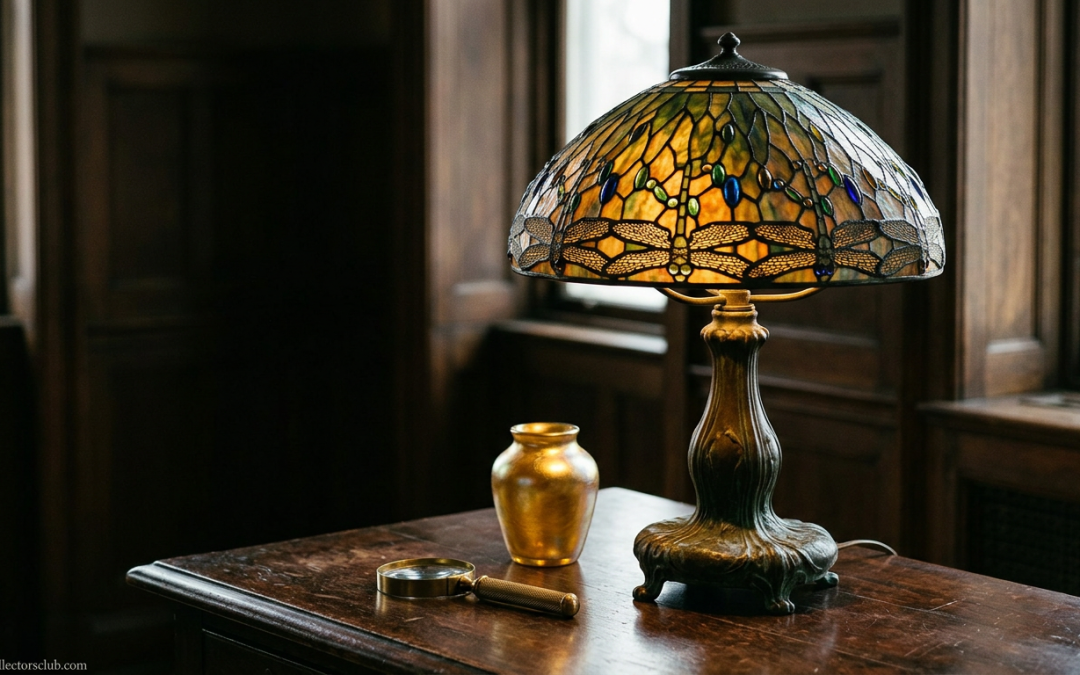
Mention Tiffany and most people picture a leaded glass lamp glowing in a dark room, its shade covered in dragonflies or wisteria. That picture has made genuine Tiffany Studios lamps some of the most valuable American decorative arts on the market. It has also made them some of the most copied.
For every real Tiffany lamp, there are countless “Tiffany-style” lamps, and a smaller but more dangerous group of outright fakes built to fool buyers. This guide covers where the real ones came from, what makes the glass special, and how to tell a period piece from a later imitation.
Louis Comfort Tiffany and His Studios
Louis Comfort Tiffany (1848 to 1933) was the son of Charles Lewis Tiffany, founder of the jewelry firm Tiffany & Co. Louis started out as a painter but turned to interiors and glass. According to the Charles Hosmer Morse Museum of American Art, which holds the largest collection of his work, he formed a decorating firm with textile designer Candace Wheeler in 1879. That firm went on to decorate some of New York’s most important homes and public buildings.
His business changed names several times over the years, which matters when you’re reading marks. Early glass was sold under the Tiffany Glass and Decorating Company, often marked with a “TG&DCo” monogram. The name Tiffany Studios came into use in the early 1900s, which was the great period for leaded glass lamps. The glass itself was made at Tiffany’s furnaces in Corona, Queens.
Who Actually Designed the Lamps
For most of the 20th century, credit went to Louis Tiffany himself. The real story came out in the early 2000s, when scholars found letters written by Clara Driscoll, who ran the Women’s Glass Cutting Department at Tiffany Studios. Her team, known as the “Tiffany Girls,” selected and cut the glass for the shades. The Brooklyn Museum credits Driscoll with the design of its Dragonfly lamp. She’s also linked to other famous patterns, including Wisteria and Peony.
That history is more than trivia. It explains why no two genuine shades are exactly alike: skilled people chose each piece of glass by hand for its color and texture.
What Makes Favrile Glass Different
Favrile was Tiffany’s name for his art glass, coined from an old word meaning handmade. Instead of painting or staining clear glass, Tiffany built color and texture into the glass itself. As The Henry Ford museum explains, Favrile glass has a surface that scatters light into a shimmering, iridescent effect. It transformed American glassmaking.
You’ll see Favrile in two main forms. Leaded lamp shades used flat and textured sheet glass with streaks, mottling, ripples, and folds, so a single leaf could shift from yellow-green to deep olive. Blown Favrile vases and bowls have a lustrous, often gold or blue iridescent surface, and genuine pieces are usually engraved on the base with “L.C. Tiffany Favrile” or “L.C.T.” and a number.
How to Tell a Real Tiffany Lamp
No single test proves a lamp is genuine. Experienced dealers look at the whole piece, and they say it’s easier to spot a fake than to confirm a real one. Here’s what they check.
- The glass. Hold the shade up to light. Genuine Tiffany glass varies within each piece, with streaks, depth, and texture. Reproductions tend to use flat, evenly colored glass. The Antique Trader points out that Tiffany’s color is part of the glass and won’t come off, while some fakes use painted glass that rubs off.
- The base. Tiffany Studios bases are bronze, heavy, and well finished, with a rich patina that develops over decades. A lightweight base, or one made of cheaper pot metal with a thin bronze-colored coating, is a red flag.
- The marks. According to Fontaine’s Auction Gallery, as reported by CNBC, the bases of Tiffany lamps almost always carry a Tiffany Studios stamp with a model number, and many shades are stamped as well. Shade marks usually appear on the inner metal rim at the bottom edge. Look for neat, evenly spaced capital letters reading “TIFFANY STUDIOS NEW YORK.”
- Signs of a forged mark. A stamp that looks shiny and fresh against an aged surface, letters that are uneven or crooked, lowercase letters, or a model number that doesn’t match the form of the lamp all deserve scrutiny.
- The pairing. Some fakes combine a real base with a later shade, or the other way around. The patina and wear on the base, the shade, and the fittings should look like they aged together.
Fontaine’s also notes that most of the lamps people call about turn out not to be genuine. Go in assuming a lamp is not a Tiffany until the evidence says otherwise.
Tiffany-Style Is Not Tiffany
Plenty of lamps are sold honestly as “Tiffany-style” or “Tiffany lamps” with no claim to be made by Tiffany Studios. Some modern lighting companies even use the word Tiffany in their brand or product names. These are decorative lamps, often attractive, but they’re reproductions with a fraction of the value. When a listing says “Tiffany,” read carefully to see whether it claims Tiffany Studios or just the style.
The same caution applies to iridescent art glass. Other makers of the period, such as Loetz in Austria, made beautiful iridescent glass of their own, and a later forged Tiffany signature can turn an unsigned vase into a costly mistake.
What Drives Value
For genuine pieces, a few factors set the price:
- The model. Large, complex floral shades like Wisteria or Peony are far rarer and more valuable than simple geometric designs.
- The glass. Shades with exceptional color and texture command a premium over duller examples of the same pattern.
- Condition. Cracked or replaced glass segments, a damaged base, or a refinished patina all reduce value. Some old repairs are expected, but they should be disclosed.
- Originality. A shade and base that left the studio together are worth more than a later marriage.
- Provenance. A documented history of ownership adds both value and confidence.
Buying Tiffany
Buy from established auction houses and specialist dealers who stand behind their attributions in writing. Ask for a condition report, ask about any replaced glass, and get a qualified opinion before spending serious money. Spend time with authenticated pieces in museums, where the Morse Museum, the New-York Historical Society, and the Brooklyn Museum all have examples on view. The more real Tiffany you see, the easier the fakes are to spot.
For deeper reading, Alastair Duncan’s books on Louis C. Tiffany are a standard reference for collectors.
Disclaimer: This article is for general information only and is not an appraisal or authentication. Reproductions and forged marks are common in this field, so consult a qualified Tiffany specialist before making a significant purchase.
© 2026 by antiquecollectorsclub.com All rights reserved. No part of this document may be reproduced or transmitted in any form or by any means, electronic, mechanical, photocopying, recording, or otherwise, without prior written permission.