
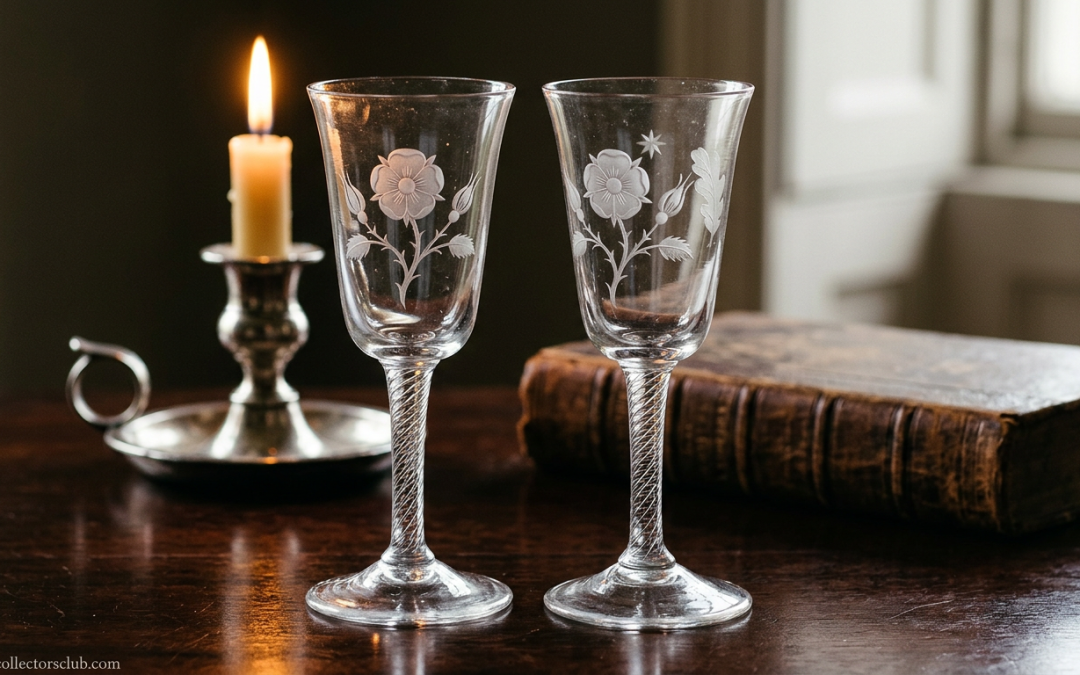
Few antiques carry as much drama in so small a package as a Jacobite wine glass. It’s a stemmed glass about six inches tall, usually engraved with a rose and a bud or two. To the people who first raised it, it was a quiet act of treason.
These glasses are among the most sought-after pieces of 18th-century English glass. They’re also among the most faked. If you’re thinking about buying one, it pays to understand both the history and the warning signs.
Who Were the Jacobites?
In 1688, King James II was pushed off the throne in the Glorious Revolution and went into exile in France. His supporters became known as Jacobites, from Jacobus, the Latin form of James. For nearly sixty years they backed the exiled Stuarts’ attempts to win back the crowns of England and Scotland. That effort ended with the defeat of Prince Charles Edward Stuart, better known as Bonnie Prince Charlie, at Culloden in 1746.
Supporting the Stuarts was treason, so loyalty had to be expressed carefully. One way was the toast. As the National Gallery of Victoria explains in its essay on Jacobite glass, sympathizers would hold a glass of wine over a bowl or glass of water and drink to the king “over the water,” meaning the king in exile. The glasses themselves were engraved with coded symbols that only fellow believers were meant to read.
When and Where They Were Made
Most authentic Jacobite glasses are wheel engraved. The engraver used small copper wheels and an abrasive paste to cut the design into the surface. Skilled wheel engravers were concentrated in London in the 1740s, so most of these glasses were probably made there, to order, for clients who shared the cause.
Dating is where the experts disagree, and it’s worth knowing both views. Older reference books placed most Jacobite glasses in the 1750s and 1760s, after Culloden, as nostalgic keepsakes. More recent research argues for an earlier date. The NGV points out that almost no glasses by the handful of major Jacobite engravers have enamel twist stems, which weren’t introduced in England until 1747 or 1748. On that view, most genuine Jacobite engraving was done in the years just around the 1745 rising, when the outcome still hung in the balance. You’ll still see dealers and auction houses describe glasses as “c. 1750” or later, so read catalog dates with that debate in mind.
The Symbols and What They Mean
The emblems are the heart of the subject, and learning them is the first step to reading any glass you pick up.
- The rose. This is by far the most common emblem: a six-petaled heraldic rose, an old Stuart badge, representing the exiled king himself.
- The buds. A bud to the right of the rose usually stands for Prince Charles Edward Stuart. A second bud on the left represents his younger brother, Prince Henry Benedict Stuart. When there are two, Charles’s bud is often the larger one, just about to open.
- The thistle. This represents the Stuart claim to the Scottish throne.
- The star. It usually sits on the opposite side of the glass from the rose and signals hope for the Stuart cause. Jacobites are said to have kissed the star after drinking the loyal toast.
- The oak leaf. This one recalls Charles II hiding in an oak tree after the Battle of Worcester and the Stuart Restoration that followed.
- Prince of Wales feathers. These assert the Stuart heir’s claim to that title.
Some glasses drop the code entirely. The National Archives has an example set that includes glasses engraved with crowns and an intertwined “JR” with the figure 8, a reference to James VIII, along with a small glass carrying a painted portrait of Bonnie Prince Charlie. Portrait glasses like that one openly declared the owner’s loyalties.
Mottos to Look For
Many glasses carry short Latin mottos. The most common is Fiat, which means “may it come to pass.” The National Museums Scotland collection includes a Fiat glass from about 1745 to 1750, linked to the Cycle Club, one of the Jacobite drinking societies. Other mottos include Redeat (may he return), Audentior Ibo (I shall go more boldly), and Revirescit (it grows green again).
At the top of the field are the “Amen” glasses. These are engraved in diamond point with a crown and verses of the Jacobite version of “God Save the King,” ending with the word Amen. Only a few dozen are known, and the handwriting on the genuine ones has been attributed to the Scottish engraver Sir Robert Strange, who fought in the Jacobite army. If you’re offered an Amen glass outside a major auction or museum context, be very skeptical.
The Fakes Problem
This is the part every collector needs to take seriously. The Corning Museum of Glass notes that many Jacobite glasses have been shown to be fakes in recent years.
The romance of the Stuart cause made these glasses popular in the 19th century, and supply never kept up with demand. According to the Antiques Trade Gazette, fakes were appearing within about seventy years of Culloden. Many of them were genuine 18th-century glasses with Jacobite emblems added later. That’s what makes the field tricky. The glass itself can be completely period, so the usual age tests pass, while the engraving that drives most of the value is a Victorian or later addition. One well-known case is Franz Tieze, an engraver working in Dublin in the late 1800s and early 1900s, who decorated period glass in the “antique style” for the collector market.
A few practical checks help, though none is conclusive on its own:
- Look at the engraving closely. Period wheel engraving tends to be soft and matte, with some surface wear. Engraving that looks unusually crisp, deep, or fresh next to a worn rim and foot deserves a second look.
- Check the wear pattern. A genuine 18th-century glass should show fine, random scratches on the underside of the foot from centuries of use. The wear on the bowl should look consistent with the wear on the foot.
- Check the foot. Earlier glasses typically have a rough pontil mark under the foot. Grinding the base smooth became common later in the century.
- Look at the design as a whole. Emblems that look crowded, awkwardly placed, or carelessly combined can point to a later hand working on a glass that wasn’t made for them.
- Ask about provenance. A glass that can be traced through a named collection or a documented sale is worth more and is far less risky.
What Drives Value
Once you’re satisfied the engraving is right, value comes down to a few things:
- Rarity of the decoration. A plain rose and bud is the most common. Mottos, portraits, and the rarer emblem combinations command more, and Amen glasses sit in a class of their own.
- The stem. Air twist and other well-made stems add appeal, and the stem type also helps with dating.
- Condition. Chips to the rim or foot, grinding to remove damage, and cloudiness all reduce value.
- Provenance. A glass from a well-known collection carries a premium, and rightly so.
Buying Your First Jacobite Glass
Buy from specialist glass dealers who offer a written description and a return policy, or from established auction houses that provide condition reports. Handle as many authenticated examples as you can, in museums and at previews. Your eye is your best defense.
For deeper reading, Geoffrey B. Seddon’s The Jacobites and Their Drinking Glasses is a standard reference, and it focuses specifically on telling genuine engraving from later work.
Disclaimer: This article is for general information only and is not an appraisal or authentication. Jacobite glass is a field with many later copies and added engravings, so consult a qualified glass specialist before making a significant purchase.
© 2026 by antiquecollectorsclub.com All rights reserved. No part of this document may be reproduced or transmitted in any form or by any means, electronic, mechanical, photocopying, recording, or otherwise, without prior written permission.