
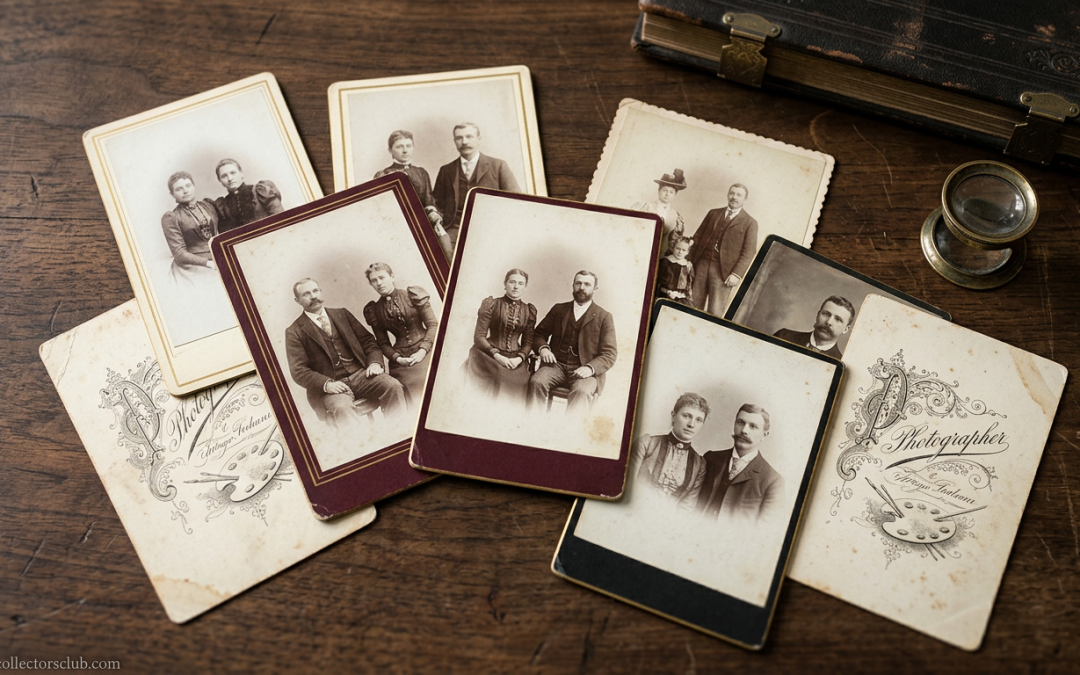
Cabinet cards are the bigger, bolder successor to the carte de visite. They’re the stiff portraits you find tucked in Victorian albums, propped in old frames, and stacked in shoeboxes at estate sales, usually showing a family, a couple, or a stern-faced great-grandparent in their Sunday best.
If you’ve started with CDVs, cabinet cards are the natural next step. The dating methods are similar, but the larger format shows more detail, the mounts are more decorative, and the subjects branch out from studio portraits into storefronts, street scenes, and working life.
This guide covers how to date a cabinet card from its mount, print, and backmark, then walks through a real example: a saloon photograph from around 1915.
What Is a Cabinet Card?
A cabinet card is a photograph mounted on a stiff card measuring about 4 1/4 by 6 1/2 inches. That’s roughly three times the size of a carte de visite, and big enough to stand on a shelf or in a parlor cabinet, which is where the name comes from.
According to the State Library of Ohio, a London studio introduced the format in 1863, and it reached the United States in 1866. Early cabinet cards looked like oversized CDVs, with the same plain studio poses. Photographers soon realized the larger size gave them room to do more, and studios began offering painted backdrops, props, costumes, and retouching that could smooth out wrinkles.
By the 1880s, the cabinet card was the most popular photographic format in the world, and it stayed on top through the 1890s. Studios kept making them into the early 20th century, but demand fell off after 1900. That year Eastman Kodak released the Brownie, and ordinary people started taking their own snapshots.
Dating a Cabinet Card by Its Mount
As with CDVs, the card mount is your best starting point. Mount colors, edges, and printed lettering all followed fashion, and studios bought them from suppliers who changed styles every few years.
Combining the State Library of Ohio’s notes with the mount dating guide from photo historian Jeremy Rowe, the general pattern looks like this:
| Feature | Typical period |
|---|---|
| White or cream mount | Popular throughout, 1860s to about 1910 |
| Gold border lines | Mostly before 1885 |
| Maroon, dark green, or black mount | Around 1880 through the 1890s |
| Scalloped edges | After the mid-1880s, especially the 1890s |
| Impressed (embossed) borders and lettering | After about 1890 |
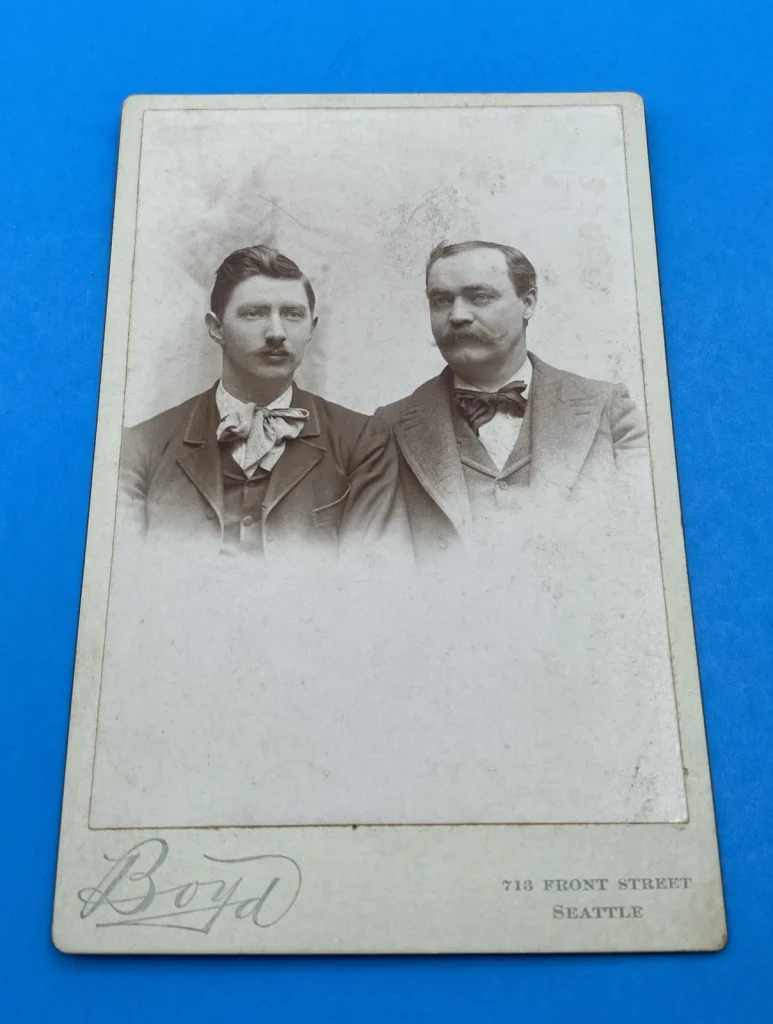
Lettering helps too. Before about 1880, the photographer’s name is usually printed in plain type below the image. From the 1880s on, the name shows up in fancier script, often in gold, and the studio imprint becomes part of the design.
Rowe’s guide adds an important warning: photographers in remote areas often kept using old mounts until their stock ran out, and popular images were sometimes reprinted on newer mounts years after the photo was taken. The mount gives you a range, not a precise date.
Albumen or Gelatin Silver? Reading the Print
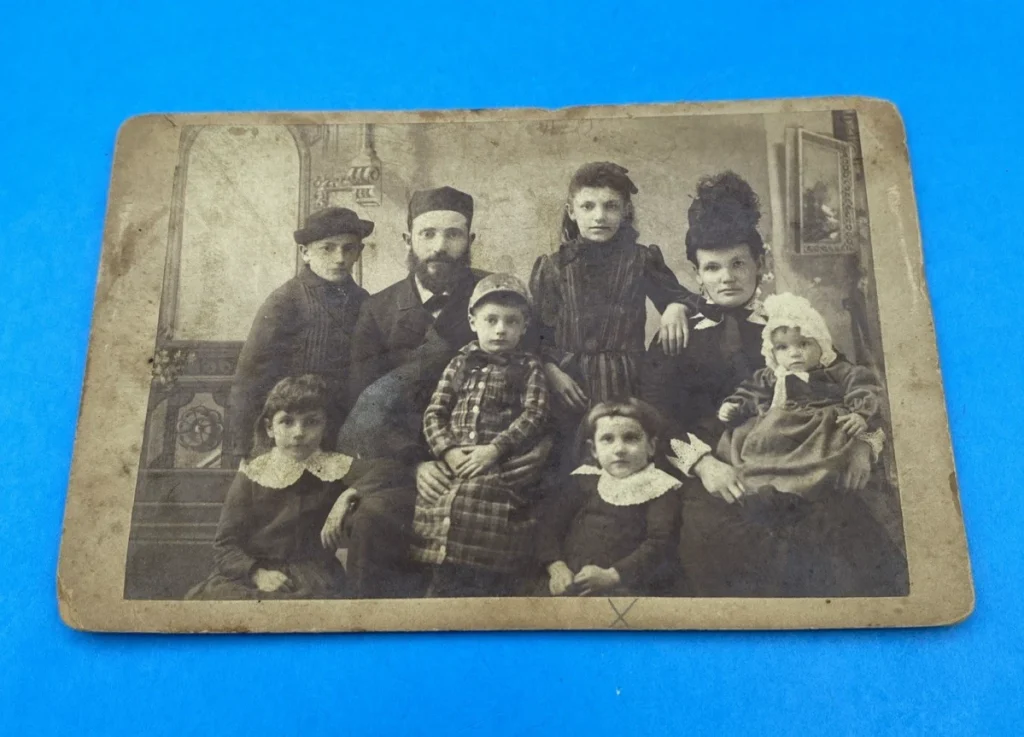
The photograph itself is another clue. Cabinet cards span a period when the photographic paper changed, and the print type can push a date earlier or later.
The State Library of Ohio offers a simple rule of thumb: most cabinet cards have a warm sepia image, and a true black-and-white image probably dates to the 1890s or later. For a closer look, the Northeast Document Conservation Center’s guide to photograph types describes the common processes:
| Print type | Common period | What to look for |
|---|---|---|
| Albumen | 1850s to about 1900 | Thin paper on a heavy mount, red-brown or purple-brown tone, yellowed highlights, fine crackle, paper fibers visible under magnification |
| Gelatin printing-out paper | About 1880 to 1910 | Warm brown or purple tone, very glossy, often faded toward yellow, no visible paper fibers |
| Collodion | Late 1880s to 1920s | Glossy purple tones or matte neutral tones, very stable, scratches easily, sometimes a faint rainbow sheen under fluorescent light |
| Gelatin silver (developing-out) | About 1880 to the present | Neutral black and white, matte or glossy, may show a silvery mirroring in dark areas |
A cheap jeweler’s loupe or a 10x magnifier is all you need to start. If you can see paper fibers running through the image, you’re probably looking at albumen. A smooth surface with no fibers points to one of the later gelatin or collodion papers.
This matters for dating because an albumen cabinet card almost certainly comes from before 1900, while a crisp black-and-white gelatin silver print on a fancy embossed mount usually belongs to the 1890s or later.
Backmarks and Photographer Research
Turn the card over. The back usually carries the studio’s name and address, and on cabinet cards it’s often a small work of art.
Early backs tend to be plain, with simple type and little decoration. From the 1880s on, backmarks grew elaborate, with flowing script, easels, palettes, cherubs, and exhibition medals. Studios didn’t design these themselves. The State Library of Ohio notes that printing companies sold customizable designs that photographers picked from sample books, so the same artwork can show up on backs from studios in different cities.
The photographer’s name and address are where the real detective work starts. City directories list businesses by year, so a studio at a specific address can often be pinned to a window of a few years. The same method works for cartes de visite, as covered in our guide to dating CDVs.
Not every cabinet card has a printed backmark. Late examples in particular may have only a small rubber stamp, a pencil note, or nothing at all, which is where the image itself has to do the work.
A Worked Example: The Capaldi Cafe, Around 1915
Here’s how those clues come together on a real photograph from our collection: a storefront view of the Capaldi Cafe at 325 West 69th Street in Manhattan, mounted in the cabinet card format.
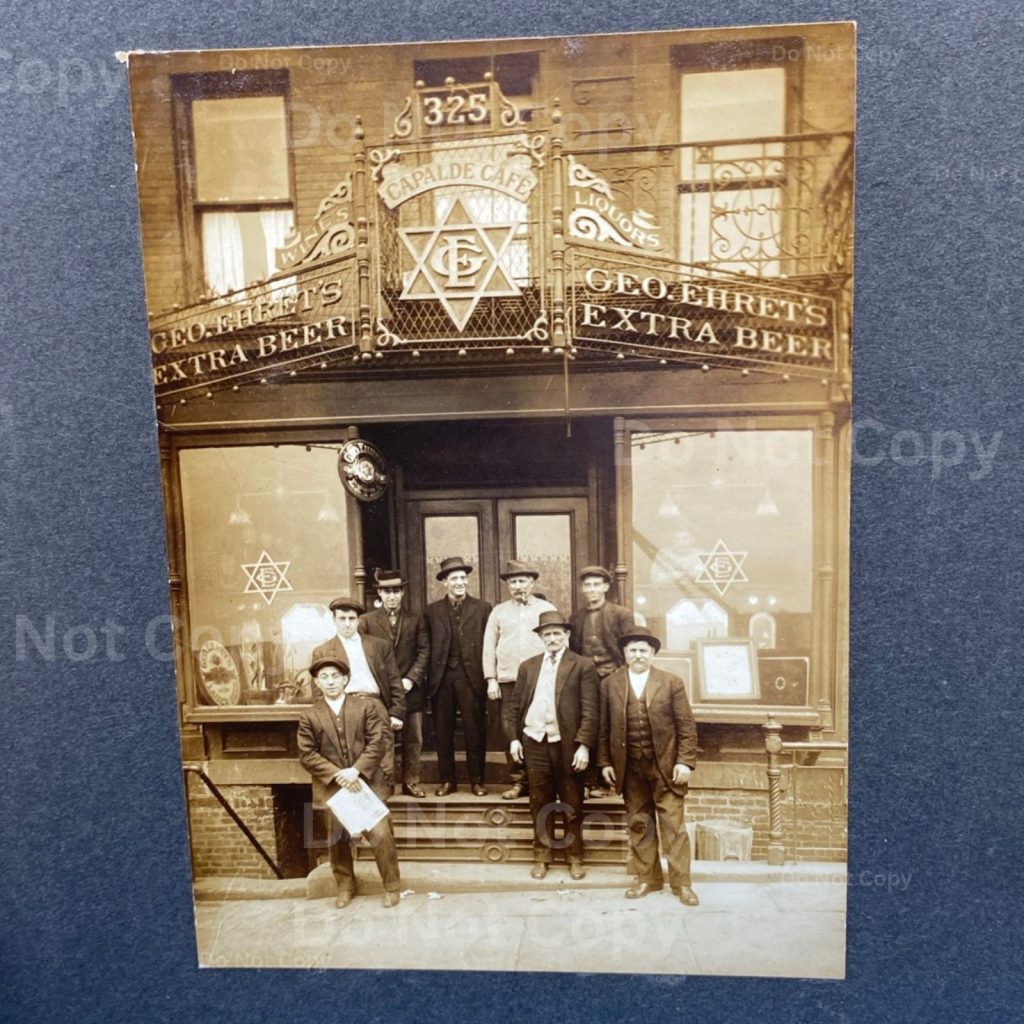
The print. The image is a gelatin silver print with neutral black-and-white tones rather than the warm sepia of albumen. That alone points to the 1890s or later.
The subject. The saloon’s front carries signs for Geo. Ehret beer, along with “Wines & Liquors” lettering, and a group of men stands at the entrance. George Ehret founded his Hell Gate Brewery in Manhattan in 1866, and it grew into the largest brewery in the nation. As 6sqft explains, New York brewers often owned saloons outright and leased them to keepers who sold only that brewery’s beer. Ehret was known as the king of beer corners, with 42 saloons by 1899.
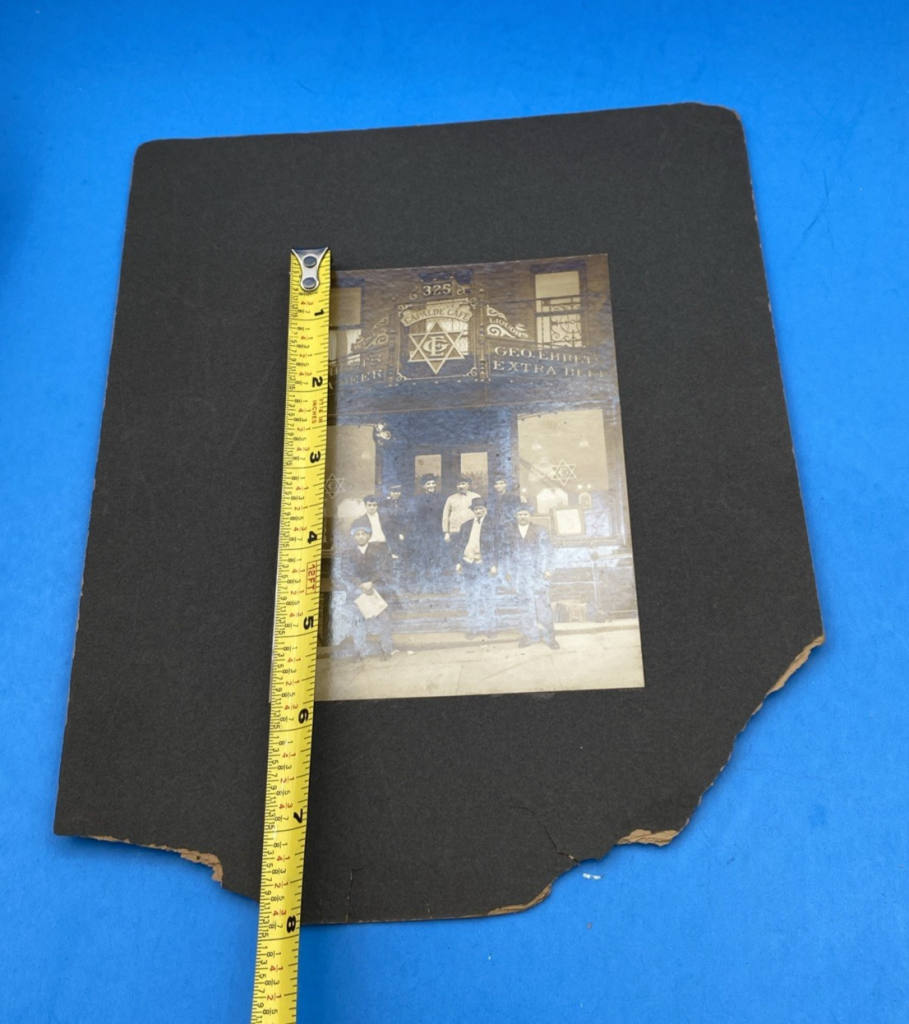
The cutoff. Prohibition began in 1920 and closed every legal saloon in the country. A working saloon with brewery signs out front has to date from before then, which sets a firm end point.
The backmark. The reverse carries a simple stamp reading “E. Marksville Photo,” not an ornate printed design. Researching the name in historical directories identified the photographer as Edward Marksville of the Bronx, which places the photo in his working years.
Put together, a gelatin silver print, a plain photographer’s stamp, a Bronx studio, and a pre-Prohibition brewery saloon all point to roughly 1910 to 1919, with circa 1915 as a fair estimate. No single clue gives the date. The agreement between them does.
It’s also a good reminder that cabinet cards weren’t only studio portraits. Commercial photographers were hired to document storefronts, workshops, and delivery wagons, and those views are now some of the most sought-after images in the format.
What Makes a Cabinet Card Valuable?
Millions of cabinet cards survive, and most anonymous family portraits sell for a few dollars. The ones that bring real money usually stand out in at least one of these ways.
Subject matter. Occupational portraits, storefronts, saloons, street scenes, and outdoor views are far scarcer than studio portraits and draw strong interest. So do images of African American sitters, Native Americans, soldiers, athletes, and early automobiles or bicycles.
Crossover appeal. A photo that matters to another group of collectors often sells for more. A saloon with brewery signs appeals to breweriana collectors, a ballplayer to sports collectors, and a storefront to local historians from that town.
Identification. A named sitter, a known address, or a dated inscription turns a photo into a documented piece of history. Researchable details add value because they add a story.
Famous sitters and photographers. Cabinet cards of actors, politicians, and performers were sold commercially, and portraits by well-known studios or signed by the sitter bring premiums.
Condition. Look for a sharp, well-contrasted image, a clean mount, and intact corners and edges. Fading, silvering, stains, trimmed edges, and creases all lower value.
Storing Cabinet Cards
Cabinet cards need the same basic care as CDVs, with a few extra concerns because of their size and heavy mounts.
Sleeve them properly. The Northeast Document Conservation Center recommends enclosures that pass the Photographic Activity Test (PAT). Uncoated polyester or polypropylene sleeves sized for 4 1/4 by 6 1/2 inch cards are easy to find from archival suppliers. Skip PVC sleeves and old magnetic albums.
Watch for brittle mounts. Many cabinet card mounts were made from cheap, acidic board that gets brittle with age. Store cards flat or upright in a snug archival box so they don’t bend, and never force a curled card flat. A conservator can safely humidify and flatten a valuable piece.
Keep them cool, dry, and dark. Light fades prints, and humidity swings make mounts warp and prints lift. A closet shelf in the living space is far better than an attic or basement.
Display copies, not originals. If you want a favorite on the wall, frame a high-quality scan and keep the original in storage.
Disclaimer: This article is for general informational purposes only and is not a formal appraisal or authentication. Dating guidelines are general and have exceptions, and market values vary with condition, demand, and provenance. For high-value items, consult a qualified appraiser or photography specialist.
© 2026 by antiquecollectorsclub.com All rights reserved. No part of this document may be reproduced or transmitted in any form or by any means, electronic, mechanical, photocopying, recording, or otherwise, without prior written permission.