
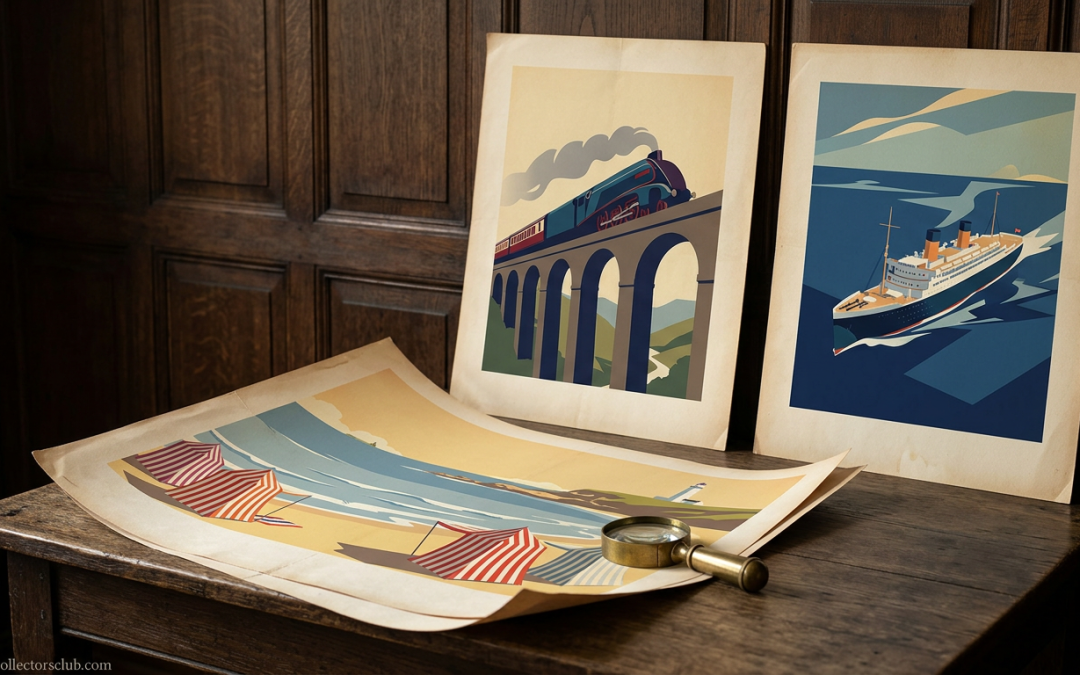
For most of the 20th century, British railway stations, Underground platforms, and shipping offices were some of the best art galleries in the country. Railway companies, London Transport, and shipping lines hired leading artists to sell the idea of travel: sunny beaches, Scottish lochs, fast trains, and faraway ports.
Those posters were printed to be pasted up, weathered, and thrown away. The ones that survived are now serious collectibles, and they’re also among the most reproduced images in British design. This guide covers the main names, how originals were made, and how to tell a period poster from a modern print.
The Golden Age of the Railway Poster
In 1923, more than a hundred British railway companies were merged into four large ones, known as the Big Four: the London and North Eastern Railway (LNER), the London, Midland and Scottish (LMS), the Great Western (GWR), and the Southern Railway. Each competed for passengers, and posters were one of their main weapons.
The quarter-century that followed, until the railways were nationalized as British Railways in 1948, is widely seen as the golden age of the British railway poster. As Georgetown University Library’s exhibition of British railway posters points out, the period lined up neatly with the creation of the Big Four. The LNER in particular commissioned artists like Tom Purvis and Frank Newbould, whose bold, simplified seaside scenes still define the look.
The scale of the output was enormous. The National Railway Museum in York holds more than 11,300 railway posters dating from 1804 to the present, including well-known characters like the Jolly Fisherman of “Skegness is SO bracing” fame.
Beyond the Railways
Travel posters weren’t just a railway story. London Transport, under its design-minded leader Frank Pick, commissioned posters from many of the best artists of the day for the Underground. Shipping lines like P&O advertised voyages to India, Australia, and the Far East with posters that are now prized by both poster and maritime collectors. Companies like Shell ran their own celebrated poster campaigns.
Two designers from this world deserve a special mention.
Abram Games (1914 to 1996) was one of the most influential British poster designers of the century. During the Second World War he was the army’s official war poster artist. Afterward he designed for clients including London Transport and the Festival of Britain. The London Transport Museum sums up his approach with his own motto, “maximum meaning, minimum means”: bold color, strong shapes, and typography built into the image.
David Gentleman (born 1930) is best known for his postage stamps, his wood engravings, and his posters for clients like the National Trust. His most famous public work is the platform-length mural at Charing Cross Underground station, showing the building of the medieval Eleanor Cross. The Victoria and Albert Museum holds proofs of the design and notes that Gentleman combined nearly 50 wood engravings to create it.
FHK Henrion, a German-born designer who worked in Britain, is another name to know. He’s important both for his posters and as a pioneer of corporate identity design.
How to Tell an Original
Railway and travel posters have been reprinted many times, by museums, publishers, and decor companies. Some reprints are honest and clearly labeled. Others are sold as originals. Here’s what to check.
- Size. Most pictorial railway posters were printed in standard sizes. The double royal (about 40 by 25 inches) was common for single images, and the quad royal (about 40 by 50 inches) was used for big landscape designs. A small poster at a standard frame size is very likely a modern print.
- The printer’s imprint. Originals usually carry a small line in the bottom margin naming the printer, such as Waterlow & Sons or the Dangerfield Printing Company. Reprints often leave it off or reproduce it oddly.
- The printing. Most period posters were printed by lithography, with flat, solid areas of rich color. Under a magnifying loupe, a modern reproduction will usually show a regular pattern of tiny dots or the fine spray of an inkjet printer.
- The paper. Originals were printed on thin, fairly cheap paper meant for pasting on walls. Thick, bright, or glossy paper is a warning sign.
- Fold lines and wear. Many original posters were folded for storage or distribution, and the fold lines show it. Genuine age shows as uneven wear, small tears at the edges, and toning in the margins.
Linen Backing Is Normal
Many vintage posters you’ll see for sale are linen-backed. That means they’ve been professionally mounted on acid-free paper and canvas to flatten folds and stabilize tears. Collectors generally accept linen backing, and it’s the standard way to preserve a poster. Just ask what restoration was done, because heavy retouching of the image itself does affect value.
What Drives Value
- The artist. Posters by sought-after designers like Tom Purvis, Frank Newbould, Edward McKnight Kauffer, and Abram Games command a premium.
- The image. Strong, iconic designs sell best, especially seaside resorts, famous trains, and well-known landmarks.
- Condition. Tears, losses, stains, and fading reduce value, though a well-restored, linen-backed poster can still be very desirable.
- Rarity. Some posters survive in good numbers, while others are known in only a handful of copies.
- Size and format. Large quad royal posters often bring more than smaller formats of similar quality.
Buying Vintage Posters
Buy from specialist poster dealers and auction houses that state the printer, date, size, and condition clearly, and that tell you about any restoration. If a price looks too good for a famous image, assume it’s a reprint until proven otherwise. Frame originals with UV-filtering glass and keep them out of direct sunlight, since poster inks fade quickly.
Disclaimer: This article is for general information only and is not an appraisal or authentication. Reprints are common in this field, so consult a qualified poster dealer or appraiser before making a significant purchase.
© 2026 by antiquecollectorsclub.com All rights reserved. No part of this document may be reproduced or transmitted in any form or by any means, electronic, mechanical, photocopying, recording, or otherwise, without prior written permission.