
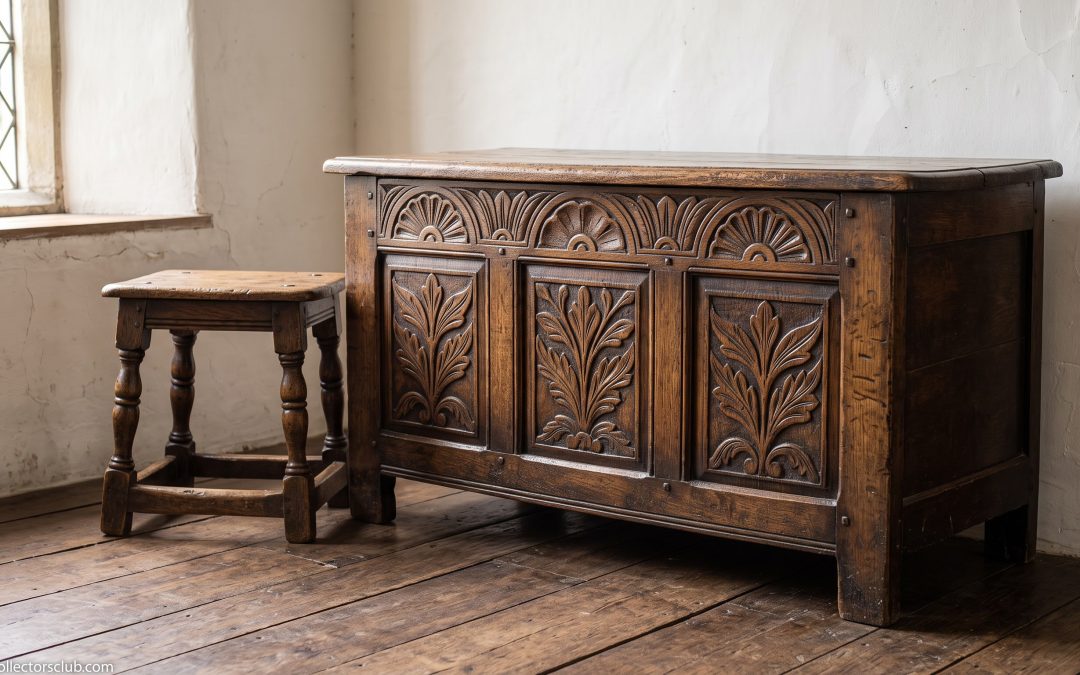
Before mahogany and walnut, there was oak. For roughly two centuries, from the Tudors to the later Stuarts, English homes were furnished in it: heavy chests, joint stools, carved cupboards, and long tables made by local joiners from timber that often grew a few miles away.
Surviving pieces are now three to four hundred years old, and good ones are some of the most satisfying antiques you can own. They’re also part of a field with a long history of improvement, embellishment, and outright faking. This guide covers the main forms, how the furniture was made, and what to check before you buy.
The Book Every Oak Collector Owns
If you get serious about early oak, you’ll end up with Victor Chinnery’s Oak Furniture: The British Tradition. First published in 1979 and reissued since, it’s still the standard reference for dealers, auctioneers, and collectors. Chinnery started out in the trade and became one of the leading scholars of everyday British furniture. The Regional Furniture Society’s obituary describes the book as his seminal work on the furniture of Britain’s middling and yeoman households in the late 16th, 17th, and early 18th centuries.
Chinnery died in 2011. A dictionary of period furniture terms he had compiled over his 50-year career was published later, and the Antiques Trade Gazette’s review is a good short introduction to how he worked, including his attribution of a group of carved chairs to a single Salisbury workshop.
Joiners, Carpenters, and Turners
In 16th and 17th century England, furniture making was split between trades. Carpenters worked with boards and heavier timber. Turners made legs, spindles, and stools on the lathe. Joiners made framed furniture held together with mortise and tenon joints. In London the joiners had their own guild, which received a royal charter from Elizabeth I in 1571.
The difference matters because it’s how you read a piece. The simplest early furniture is boarded: planks nailed or pegged together, like the classic six-plank chest. Joined furniture is built as a frame of upright stiles and horizontal rails. The tenon on the end of one piece fits into a mortise cut in the other, and the joint is locked with a wooden peg driven through both. Thin panels sit loose in grooves inside the frame so they can shrink and swell without splitting. Furniture historian Adam Bowett’s study of early joinery in Britain traces how framed construction developed out of these earlier methods.
The Main Forms
- Chests. The most common survivor. Boarded and joined chests were used to store linen, clothes, and valuables, and the fronts are often carved. Some carry initials and a date.
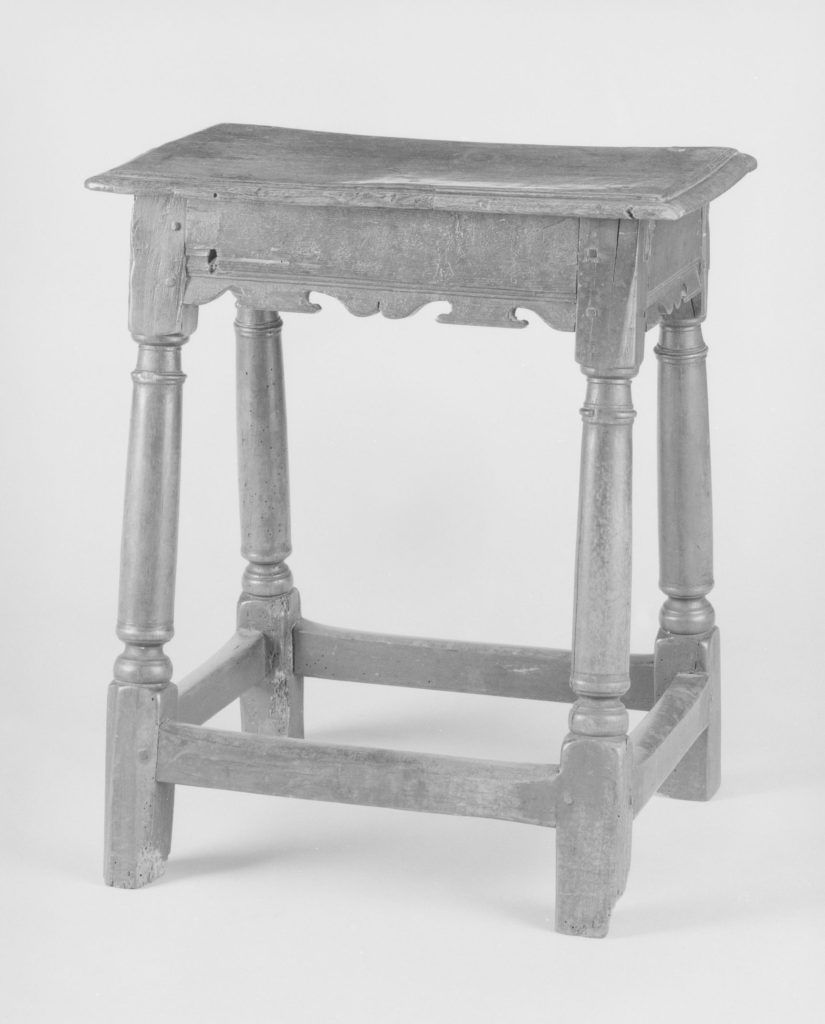
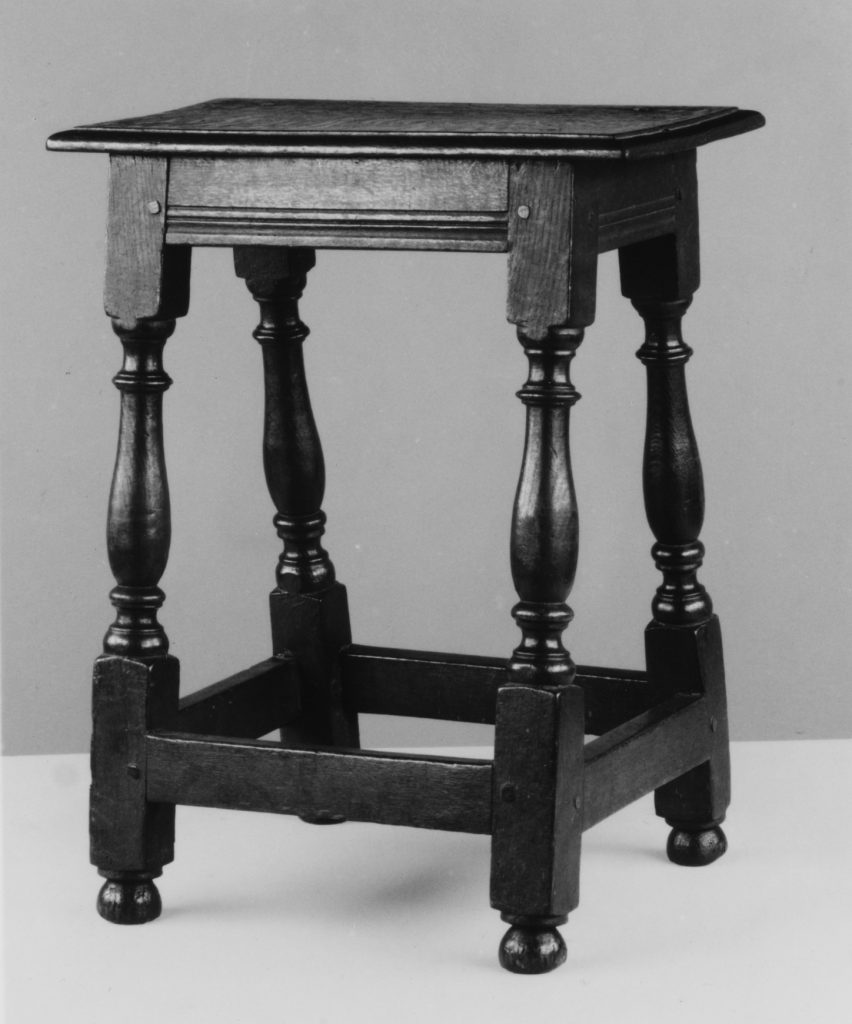
- Joint stools. The everyday seat of the period, with four turned legs joined by rails and stretchers. Today they’re popular as small side tables. Tops were often replaced, so check that the top belongs.
- Court and press cupboards. These were status pieces. A court cupboard is open in its tiers for displaying plate, while a press cupboard is enclosed for storage. The Victoria and Albert Museum has a fine carved example from the early 17th century.
- Tables. Long joined tables (“refectory” is a later name) and, from the 17th century, gateleg tables that fold away. A joined oak table in the V&A collection is displayed in the kitchens at Hampton Court Palace.
- Wainscot chairs. Heavy armchairs with a panelled back, usually reserved for the head of the household.
- Later forms. Chests of drawers, dressers, settles, and Bible boxes became more common as the 17th century went on.
When Oak Gave Way to Walnut
After the Restoration of Charles II in 1660, fashionable furniture moved toward walnut, veneers, and cabinetmaking with dovetailed joints. Oak didn’t disappear, though. Country joiners kept making oak furniture in traditional forms well into the 18th century and beyond, especially dressers, chests, and tables.
That’s worth remembering when you shop. “17th century style” doesn’t mean 17th century, and a lot of what’s sold as early oak is honest 18th century country work. That’s perfectly collectible, as long as it’s described and priced for what it is. Regional styles help with dating and attribution, and collectors learn to recognize Lancashire, Yorkshire, West Country, and Welsh pieces by their carving and construction.
How to Tell Period Oak
- Color and surface. Centuries of wax, dirt, handling, and light give period oak a deep, uneven color, darker in the recesses and lighter where hands touched it most. Collectors call it patina, and an original surface is a big part of the value. Stripped or heavily refinished pieces are worth much less.
- Wear in the right places. Stretchers worn down by feet, rounded edges on tops and seats, and worn drawer runners are what you expect to see. Wear that is even all over, or shows up where nobody would touch, suggests artificial distressing.
- Shrinkage. Oak shrinks across the grain as it ages. Pegs stand slightly proud of the surface, panels pull away from their grooves, and round tops become slightly oval.
- Tool marks. Early boards were split (riven) or pit-sawn and hand planed, so thicknesses vary and the surfaces show faint ripples. Mouldings were often cut with a simple scraping tool. Curved saw marks from a circular saw point to the 19th century or later.
- Pegs and fixings. Period pegs were shaped by hand and are rarely perfectly round. Machine-made dowels, modern screws, and wire nails are signs of later work or repair.
- The back and underside. Look at the surfaces nobody polished. Genuine age shows as dry, oxidized, grayish-brown wood. Fresh stain on the inside is a warning sign.
Victorian Carving and Married Pieces
The Victorians loved anything that looked Elizabethan or Jacobean. Many plain 17th century chests and cupboards had carving added in the 19th century to make them look grander, and some “Jacobean” furniture was assembled from old panels and new wood. Signs of later carving include crisp, sharp detail with no softening from wear, cut surfaces that are lighter than the wood around them (or stained to hide it), and carving that spreads across rails and stiles a period joiner would have left plain.
The other common problem is the marriage: a top and base from two different pieces put together as one. Court cupboards, dressers, and chests of drawers are the usual suspects. Check that the color, timber, construction, and wear match from top to bottom.
None of this has to rule a piece out. A 17th century chest with Victorian carving is still a 17th century chest. Just make sure you’re paying for what it is.
What Drives Value
- Original surface. Good, untouched color is the first thing experienced buyers look for.
- Originality. Replaced tops, feet, hinges, and drawers all reduce value. A few period repairs are normal.
- Form and rarity. Court cupboards, wainscot chairs, and early gateleg tables are scarcer than chests and command more.
- Dates and initials. A carved date or set of initials adds interest, though dates were sometimes added later too.
- Quality and proportion. Well-made, well-proportioned pieces with lively carving always stand out.
Buying and Living With Early Oak
Buy from specialist dealers and auction houses that give detailed condition reports, and ask directly what has been replaced or restored. Old sale records are a useful way to learn what similar pieces bring, and collecting auction catalogs is one of the best ways to build that knowledge. Once a piece is home, keep it away from radiators and direct sun, avoid big swings in humidity, and never strip it. A light coat of good wax now and then is all it needs.
Disclaimer: This article is for general information only and is not an appraisal or authentication. Early oak is a field with many later alterations and reproductions, so consult a qualified furniture specialist before making a significant purchase.
© 2026 by antiquecollectorsclub.com All rights reserved. No part of this document may be reproduced or transmitted in any form or by any means, electronic, mechanical, photocopying, recording, or otherwise, without prior written permission.