
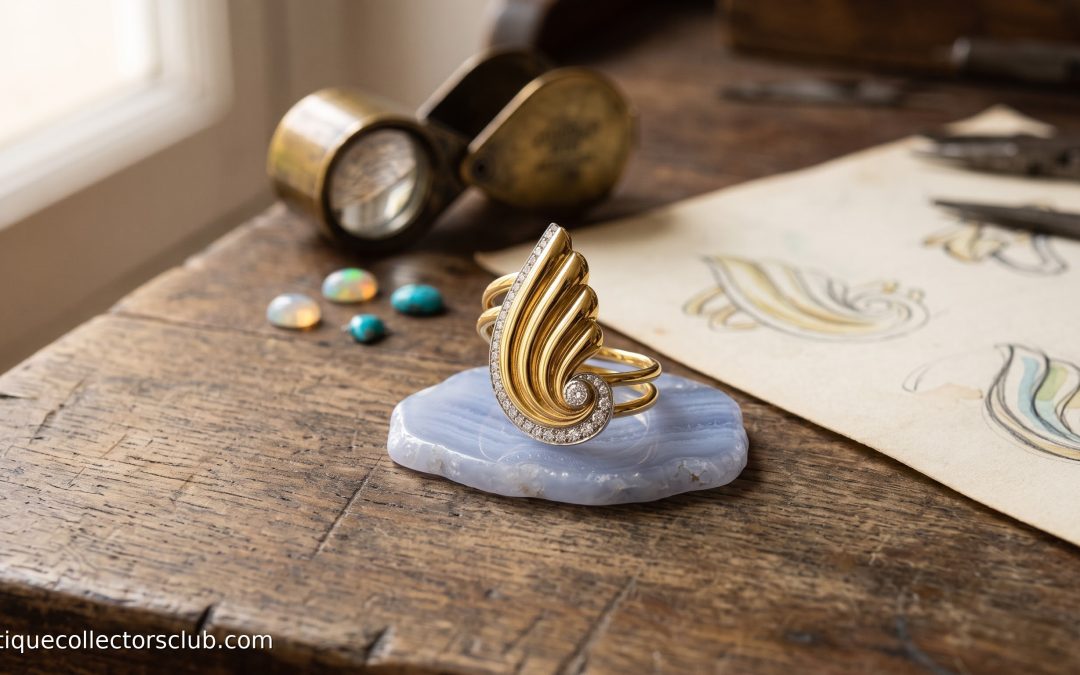
Most great jewelers made sure you knew whose work you were wearing. Suzanne Belperron did the opposite. She almost never signed a piece, and when asked why, she answered that her style was her signature. Today that style is enough to send auction estimates soaring, and the lack of a signature makes her one of the most interesting and most challenging names a jewelry collector can chase.
This guide covers who she was, what her work looks like, and what to know before you buy anything described as Belperron.
From the Jura to Paris
She was born Madeleine Suzanne Vuillerme in 1900 in Saint-Claude, in the Jura mountains of eastern France, and trained at the fine arts school in Besançon. In 1919 she moved to Paris and was hired as a designer and model maker by Jeanne Boivin, who had taken over the jewelry house of her late husband, René Boivin. In 1924 she married the engineer Jean Belperron, and the Phillips catalog notes for one of her brooches record that she was made co-director of Boivin the same year.
At Boivin she developed the look that would define her career: bold, rounded, sculptural jewels at a time when Art Deco favored crisp geometry. Her work there was never credited to her, and in 1932 she left to join Bernard Herz, a leading Paris dealer in pearls and precious stones who had long supplied Boivin. With Herz she was finally the house’s recognized designer, and her jewels began appearing in Vogue.
The War and After
Herz was Jewish, and the Occupation put the business in danger. After his first arrest in 1941, Belperron registered a new company in her own name to keep the firm alive, and she ran it through the war years. When Herz’s son Jean returned to Paris in 1945, he became her partner and the business was renamed Jean Herz-Suzanne Belperron. According to Rapaport’s profile of Belperron, the firm stayed active until 1974. She was made a Chevalier of the Légion d’honneur in 1963 and died in 1983.
What Her Jewelry Looks Like
Belperron’s work is easier to recognize than to describe, but a few things come up again and again.
- Unexpected materials. She set precious stones into carved chalcedony, rock crystal, smoky quartz, and even wood, choosing materials for their look rather than their price. Blue chalcedony paired with sapphires is one of her best-known combinations.
- Sculptural volume. Her rings, cuffs, and clips are rounded and three-dimensional, often with large domed or carved forms instead of flat, outlined settings.
- Textured gold. Many pieces use high-carat yellow gold with a hammered or matte, almost raw surface.
- Nature and the wider world. Shells, leaves, flowers, and stylized motifs drawn from African, Asian, and ancient art all appear in her designs.
Her clients included royalty and figures from fashion and the arts. Among the most famous commissions was a blue chalcedony parure for the Duchess of Windsor.
The Signature Problem
Because her jewels weren’t signed, many Belperron pieces spent decades sold as anonymous French gold or misattributed to other houses, including Boivin. Collectors and experts now rely on three main kinds of evidence.
- Maker’s marks. Belperron’s jewels were made by outside workshops, and their French marks help date a piece. Pieces made between 1942 and 1955 often carry the mark of Groené et Darde, and later pieces the mark of Darde et Fils. A maker’s mark alone doesn’t prove a Belperron design, since those workshops made jewelry for other clients too.
- Her archives. Two sets of records survive. Ward Landrigan, the New York jeweler who owns Verdura, bought the Belperron name and her design archive in 1999, as The Jewellery Editor reported. Separately, the Paris jewelry expert Olivier Baroin discovered her personal archives in December 2007, including order books recording clients and commissions.
- Expert certificates. Major auction houses now usually sell Belperron pieces with a certificate from a recognized expert, most often Baroin, that matches the jewel to archival records.
For collectors, the most useful book is Suzanne Belperron by Sylvie Raulet and Olivier Baroin, published in 2011, which reproduces many of her designs and photographs from the archives.
The Market
Belperron’s reputation faded after her death, then came roaring back once the archives surfaced. The turning point was May 2012, when Sotheby’s Geneva sold the jewels from her personal collection. According to Artdaily’s report on the sale, all 60 lots sold for a total of CHF 3,224,950 ($3,459,307), more than three times the pre-sale estimate.
Prices still vary enormously. Small gold pieces and rings can sell in the low thousands, while major jewels with important stones and strong provenance bring six figures. What separates the two, beyond the materials, is documentation.
Buying Belperron
- Insist on a certificate. A piece described as “Belperron” or “attributed to Belperron” without expert authentication should be priced as unattributed gold and stones, not as Belperron.
- Check the marks. Look for French assay marks and a maker’s mark consistent with her workshops and the claimed date.
- Watch the wording. “In the style of” and “Belperron-inspired” mean exactly that. Her look has been widely copied, and modern pieces are also made from her archival designs, so ask whether a jewel is vintage or new.
- Ask about provenance. A documented commission, family history, or earlier sale record adds both confidence and value.
If French designer jewelry is out of reach for now, the same eye for quality, materials, and documentation applies to any antique or vintage piece. You can browse examples in TheHistoryShop’s jewelry collection, or read our guides to Wartski and the great British jewelry houses and Victorian mourning jewelry.
Disclaimer: This article is for general information only and is not an appraisal or authentication. Belperron attributions require expert review, so consult a qualified specialist and ask for an authentication certificate before making a significant purchase.
© 2026 by antiquecollectorsclub.com All rights reserved. No part of this document may be reproduced or transmitted in any form or by any means, electronic, mechanical, photocopying, recording, or otherwise, without prior written permission.