
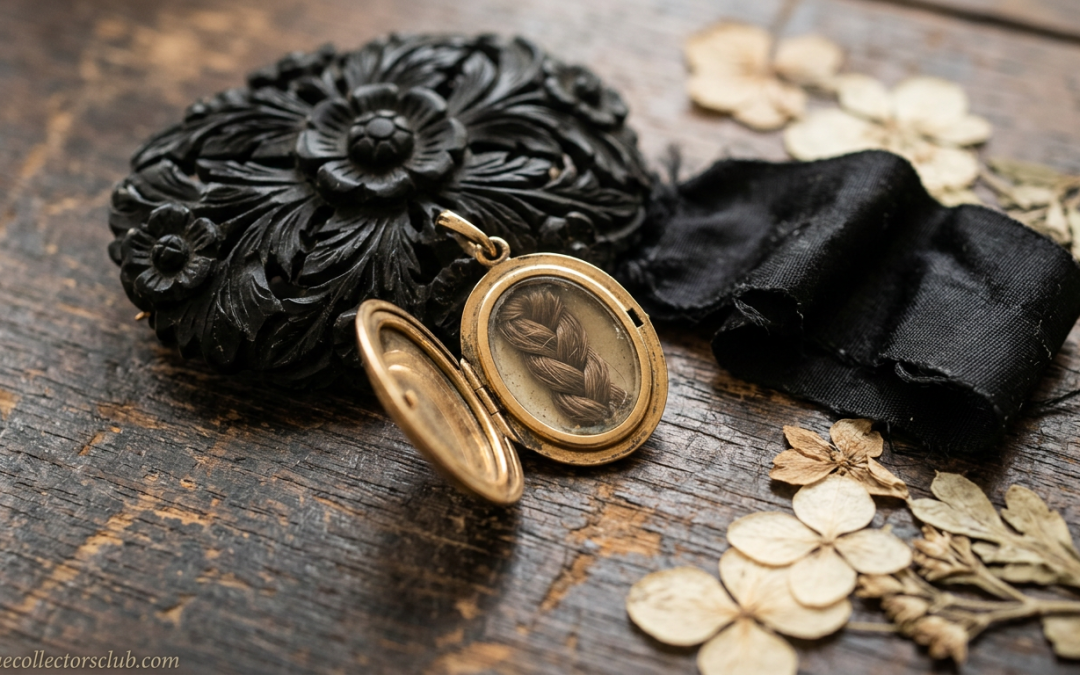
Few kinds of antique jewelry carry as much feeling as mourning jewelry. A black brooch, a ring inscribed “In Memory Of,” a locket with a lock of hair behind glass: each was made to keep someone close after they were gone. Today these pieces are among the most collected areas of Victorian jewelry, valued for their craftsmanship, their history, and the very personal stories they hold.
Before the Victorians
Jewelry made to remember the dead is much older than the 19th century. In the 16th and 17th centuries, memento mori jewelry, often decorated with skulls and skeletons, reminded the wearer of their own mortality. By the 18th century, the focus had shifted to remembering a specific person. Georgian mourning rings were often given out at funerals, engraved with the name and date of death of the deceased, and decorated with urns, weeping willows, and grieving figures painted in sepia.
Enamel color carried meaning too. Black enamel was generally used for married adults, while white enamel often marked the death of an unmarried person or a child.
Queen Victoria and the Height of Mourning
Mourning jewelry reached its peak after December 1861, when Prince Albert died. Queen Victoria wore mourning for the rest of her life, four decades in all, and the country followed her lead. Strict rules governed how long and in what way people mourned, and jewelry was part of that code.
During full mourning, jewelry was dark and matte, with no sparkle. As time passed and mourning moved into its later stages, softer touches were allowed, such as pearls, often read as a symbol of tears, along with gray, mauve, and purple stones like amethyst.
The Materials
Whitby Jet
The most prized mourning material is jet from Whitby, on the Yorkshire coast. Jet is fossilized wood, compressed over millions of years into a hard, black material that can be carved and polished to a deep shine. Whitby’s jet workshops grew rapidly in the mid-19th century, turning out brooches, bracelets, necklaces, and lockets, many with detailed carved flowers, leaves, and cameos.
Imitations of Jet
Demand for jet was so high that cheaper substitutes became common:
- French jet is actually black glass. It’s often faceted and very shiny.
- Vulcanite is hardened rubber, a 19th-century invention. It could be molded into designs that looked carved.
- Bog oak is wood preserved in Irish peat bogs, carved into brooches and bracelets, often with Irish motifs.
- Black enamel and onyx were used on gold settings, especially in rings and lockets.
None of these are fakes in themselves, since they were sold openly as alternatives in the period. The problem only arises when a piece is sold today as Whitby jet when it isn’t.
Hairwork
Human hair was the most personal mourning material of all. A lock of the deceased’s hair might be placed in a locket, set behind glass on the back of a brooch, or worked into elaborate designs. Two main styles appear. In palette work, hair is laid flat and cut or arranged into shapes like feathers, wheat sheaves, or willows. In table work, hair is braided into tubes and chains on a special table, then made into bracelets, watch chains, and earrings.
Inscriptions
Many mourning rings and brooches carry the words “In Memory Of,” often in gold letters on a band of black enamel. Engraved names, initials, and dates on the back are a real bonus, since they can sometimes be traced to an actual person.
How to Tell Whitby Jet From Imitations
Telling jet from its substitutes is one of the most useful skills for a mourning jewelry collector. A few clues help:
- Weight. Jet is surprisingly light. Glass is noticeably heavier for its size.
- Temperature. Jet feels warm to the touch. Glass feels cold and stays cold longer.
- Surface. French jet often has crisp facets and a glassy shine. Look for chips with the curved, shell-like break typical of glass.
- Molding marks. Vulcanite was molded, so look for fine seam lines and design details that are a little too uniform. Old vulcanite can also fade to a brownish color.
- Carving. Real jet was carved by hand, so the detail is usually crisp and slightly irregular.
Dealers sometimes use a streak test, rubbing a piece on unglazed porcelain: jet leaves a brown streak, while vulcanite and glass don’t. It can damage the piece, though, so leave it to a specialist and never try it on a visible area.
What Collectors Look For
Condition
Jet is brittle and can chip or crack if dropped. Check edges and high points of carving closely. Enamel loss on rings and lockets is common and affects value, as does damage to hairwork, which can become loose, faded, or moth-damaged.
Originality
Look out for marriages and later additions. Some lockets have had hair added by later owners or sellers to make them more appealing as mourning pieces. Hair that looks too fresh, glued in, or out of keeping with the setting is worth questioning.
Gold and Hallmarks
Gold mourning rings and lockets may carry British hallmarks, which can help with dating. The 9, 12, and 15 carat gold standards were introduced in 1854, so those marks point to the second half of the century. Many smaller pieces are unmarked, which is normal for the period and not a red flag on its own.
Personal Details
Names, dates, and inscriptions add interest and often value. A ring with a legible name and date that can be connected to a real person and family history is far more interesting than an anonymous piece.
Caring for Mourning Jewelry
Store jet pieces separately so they don’t scratch or knock against harder stones. Keep hairwork dry and away from direct light, and avoid cleaning it with water or chemicals. Enamel should only be wiped gently with a soft, dry cloth.
The End of an Era
By the 1880s and 1890s, the strict rules of Victorian mourning were softening, and fashion was moving on. Mourning jewelry never disappeared entirely, but the vast output of the mid-century years gave way to simpler remembrance pieces. What remains is a remarkable body of work that tells us how the Victorians loved, lost, and remembered.
This article is for general information only. It is not an appraisal or a guarantee of authenticity or value. For buying, selling, or insurance decisions, consult a qualified appraiser or a reputable specialist dealer.
© 2026 by antiquecollectorsclub.com All rights reserved. No part of this document may be reproduced or transmitted in any form or by any means, electronic, mechanical, photocopying, recording, or otherwise, without prior written permission.