
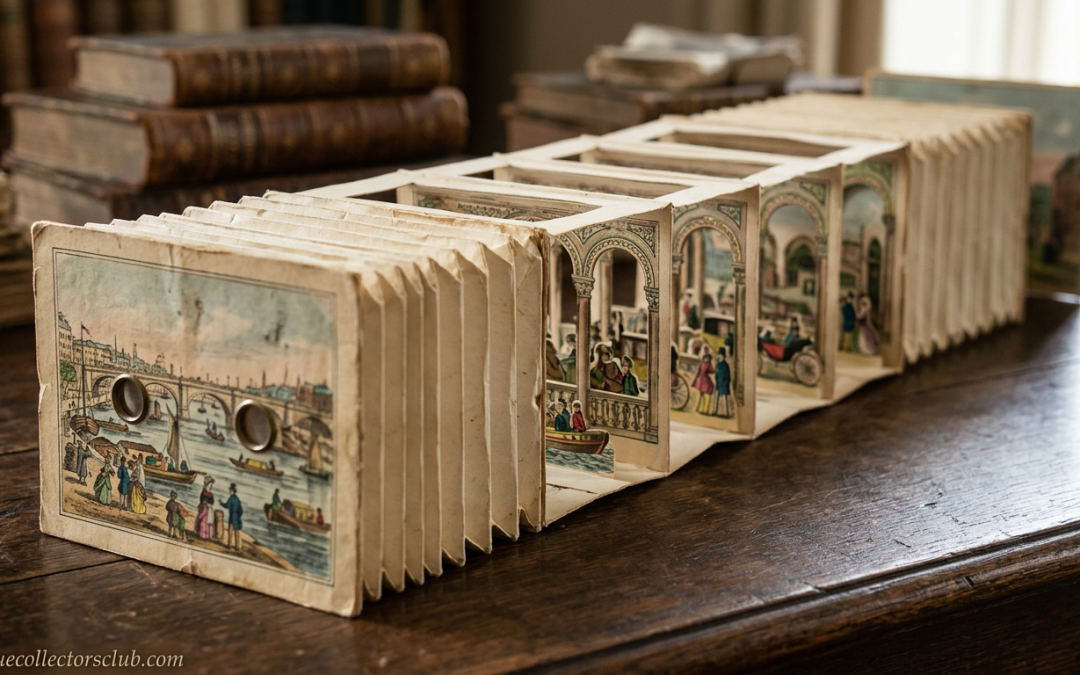
Pull a Victorian paper peepshow open, put your eye to the little hole in the front, and a flat paper booklet becomes a deep, crowded scene: a ballroom full of dancers, a tunnel stretching under a river, the glass halls of the Great Exhibition. It’s a simple trick, and it still works almost two hundred years later. That’s a big part of why these fragile objects have a devoted following among collectors of prints, books, and ephemera.
What Is a Paper Peepshow?
A paper peepshow is a series of printed, hand-cut paper panels joined along both sides by folding paper or cloth sides, like the bellows of an accordion. Each panel has its center cut away to show part of a scene, and the panels are stacked one behind another. When the peepshow is pulled open and viewed through a peephole in the front panel, the layers line up and the scene appears to recede into the distance.
Closed, a peepshow folds flat into a cover, often no bigger than a small book. Open, it can stretch out to several times its folded depth. Collectors and dealers sometimes call them tunnel books, a name that fits the long, receding view.
Where They Came From
The idea grew out of 18th-century perspective prints. In Germany, the Augsburg engraver Martin Engelbrecht produced sets of engraved, hand-colored cut-out scenes that were slotted one behind another in a viewing box, creating a miniature stage. Similar optical entertainments were popular across Europe, from perspective views to toy theaters.
The folding, self-contained peepshow came into its own in 19th-century England. It was cheap enough to sell as a souvenir or a children’s novelty, and printers could turn out new scenes quickly to match whatever the public was talking about.
Popular Subjects
The best peepshows are small snapshots of what Victorians found exciting, which is exactly why collectors love them. Subjects that turn up again and again include:
The Thames Tunnel. When the tunnel under the Thames opened in 1843, it was a sensation, and peepshows of its arched passage were sold to visitors as souvenirs. The long, repeating arches were made for the format, and Thames Tunnel peepshows remain one of the classic subjects.
The Great Exhibition of 1851. The Crystal Palace, with its soaring glass interior and crowds of visitors, inspired a wave of peepshows that captured the scale of the building in a way a single print couldn’t.
Royal and public events. Coronations, processions, and celebrations were natural subjects for a format built around crowds and depth.
Theater, gardens, and travel scenes. Stage interiors, pleasure gardens, and views of famous places all appear, along with fanciful scenes made purely for entertainment.
Event peepshows tend to attract the most interest, because they combine visual appeal with a clear historical moment.
What Collectors Look For
Completeness
A peepshow is only as good as its full set of panels. Check that the front panel with its peephole, every intermediate panel, and the back scene are all present. Missing panels are not always obvious when the peepshow is closed, so open it carefully and count. If you can, compare it with a recorded example of the same title.
The Folding Sides
The folding sides take the most stress, and they’re usually the first part to fail. Look for tears, splits along the folds, and old repairs. Original sides in sound condition add a great deal to value.
Original Color
Many early peepshows were hand-colored, and fresh, unfaded color makes a big difference. Later examples are more often printed in color by lithography. Neither is wrong, but you should know which you’re looking at, and be wary of color that looks too bright or too even for its age.
Cover and Title
An original cover, slipcase, or title label helps identify the peepshow, and the printer’s name or a date can make it easier to place. Peepshows that survive with their original covers are noticeably scarcer than loose ones.
Overall Condition
Expect some wear on a paper toy that was meant to be handled. Light foxing and edge wear are normal. Heavy staining, brittle paper, cut-down panels, and modern tape are the problems that cost real money.
Repairs and Restoration
Careful, reversible repairs by a paper conservator are generally acceptable and can stabilize a peepshow that would otherwise fall apart. What hurts value is amateur work: pressure-sensitive tape, glue that has yellowed, and repainting. If a seller mentions repairs, ask what was done and by whom. A good dealer will tell you.
Spotting Reproductions
Facsimile peepshows have been produced for museum shops and the gift trade, and modern artists also make tunnel books in the traditional style. Most aren’t made to deceive, but they can be passed off as old once they leave their original packaging.
A few checks help:
- Look at the printing under a magnifier. A regular pattern of tiny dots usually means modern photographic printing, not an engraving or lithograph from the period.
- Feel the paper. Old paper has a softness and texture that modern bright white stock lacks.
- Check the construction. Staples, plastic, modern adhesives, and crisp machine-cut edges are warning signs.
- Look for a modern imprint. Reproductions often carry a museum or publisher credit, sometimes on the cover or a removed wrapper.
Caring for a Peepshow
Store peepshows closed, flat, and out of direct light. Leaving one open on display for long periods strains the folding sides and fades the color. If you want to display one, open it for a short time, keep it away from windows, and handle it as little as possible. An archival box or folder gives good protection.
Where to Find Them
Paper peepshows turn up at antiquarian book fairs, ephemera fairs, and specialist auctions of books, prints, and children’s material. Dealers in early children’s books and optical toys are often the best source, since they know the titles and can tell you whether an example is complete. Good examples are not common, so it pays to be patient and buy the best condition you can afford.
Further Reading
The standard reference is Ralph Hyde’s Paper Peepshows: The Jacqueline and Jonathan Gestetner Collection (2015), a well-illustrated survey of one of the finest private collections, with detailed descriptions of individual titles. It’s an excellent guide to what exists and what complete examples should look like.
This article is for general information only. It is not an appraisal or a guarantee of authenticity or value. For buying, selling, or insurance decisions, consult a qualified appraiser or a reputable specialist dealer.
© 2026 by antiquecollectorsclub.com All rights reserved. No part of this document may be reproduced or transmitted in any form or by any means, electronic, mechanical, photocopying, recording, or otherwise, without prior written permission.